
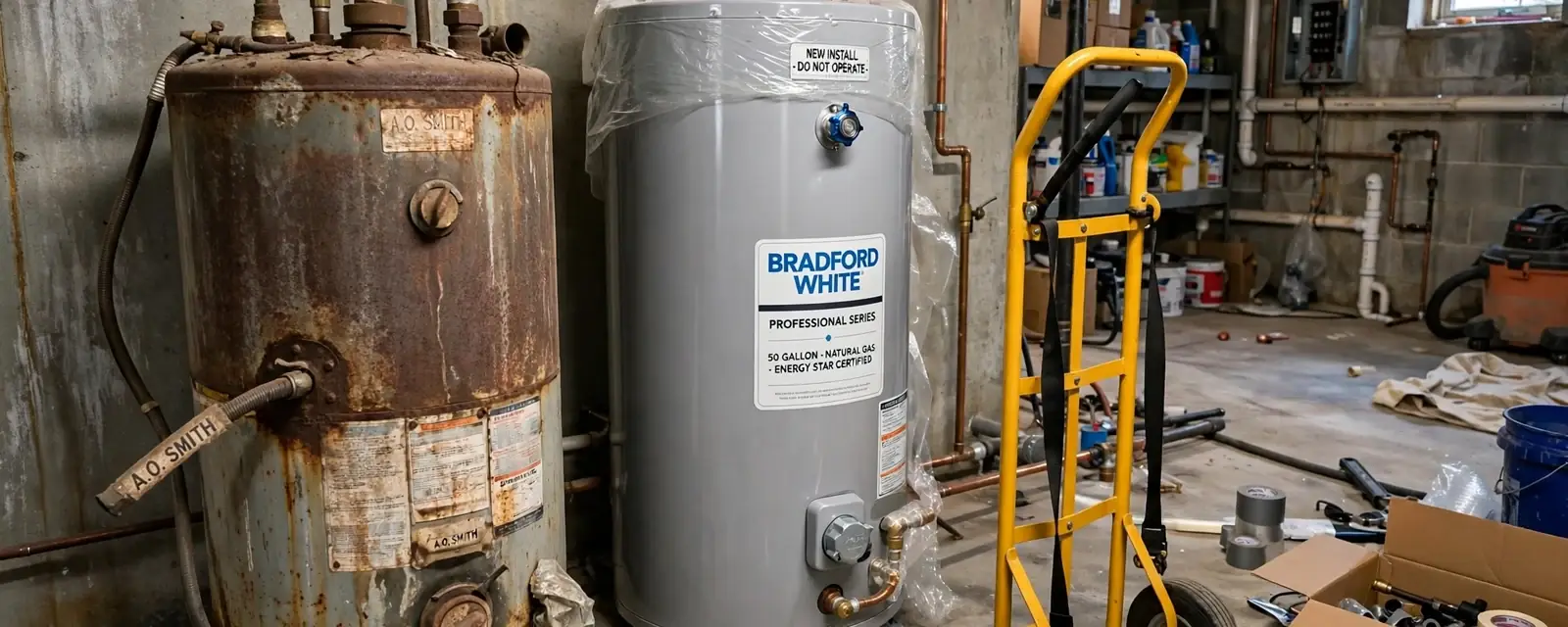
Dead or flooding water heater in Millburn
A tank that is flooding the floor or has stopped heating altogether is a same-day problem for most households. Emergency water heater replacement in Millburn, NJ is available 24/7 through the dispatch line. While you wait, close the cold water valve above the tank, turn off the breaker or set the gas control to off, and move anything valuable off the floor.
Not every failure ends in a new tank, and a plumber should say so plainly. A leaking fitting or a bad element on a younger heater is a repair, which water heater repair covers. A tank that has rusted through is not fixable, and the job becomes choosing what goes in its place.
Gas smell near the heater
Do not relight a pilot or flip switches. PSE&G says to exit the building immediately, move at least 350 feet away, then call PSE&G at 1-800-880-PSEG (7734) or 911. A plumber can deal with the heater once the utility clears the house.
Signs a tank has failed
Tanks give notice before they quit, though many homeowners miss it. A steel tank is lined with glass, and a sacrificial anode rod inside takes the corrosion first. Once the rod is spent and the lining cracks, the steel rusts from the inside out.
Signs the tank itself is done
- Water pooling at the base or weeping from the body seam
- Rust-colored hot water that stays that color while the cold tap runs clear
- Rumbling or popping from a thick layer of sediment
- Hot water that runs out faster than it used to
- Repeated element or thermostat failures on an older electric tank
- A heater that came with the house and has no service history
A weeping fitting is not on this list, since fittings can be repaired. Water through the tank wall is. Check the date code on the data plate, but treat age as a clue and condition as the verdict.
Replace or repair, side by side
| What is found | Leans toward | Reason |
|---|---|---|
| Leak at a pipe connection or valve | Repair | The tank itself is still sound |
| Water seeping from the tank body | Replace | The steel or lining has failed |
| Failed element or thermostat, tank dry | Repair | A part has failed, not the vessel |
| Rusty hot water and a crusted drain valve | Replace | Corrosion is inside the tank |
| Second major repair on an older unit | Replace | Money is going into a tired tank |
| Error code on a newer unit | Repair | Sensors and controls can be swapped |
A table cannot see your tank. A plumber's inspection decides the close calls, and an honest one will tell you which side of the line you are on.
Tank flooding or finished for good?
Close the cold supply and cut the power or gas, then call the 24/7 line. Name the fuel type and where the heater sits.
What happens on a replacement visit
Confirm the swap
Fuel, size, venting and existing connections are checked against the new unit before anything is cut.
Shut down and drain
Water, power or gas is isolated and the old tank is drained.
Disconnect and remove
Water lines, gas line, vent and discharge pipe come off, and the old unit is moved out of its spot.
Set the new tank
The heater goes on a pan or level base with new shutoff valves, connectors and a T&P valve discharge pipe.
Fill, purge and fire up
The tank is filled before power or gas goes on, a hot tap runs until air is out, and the venting and every joint are checked.
Walk through the settings
Temperature, shutoffs and what to watch over the first few days.
Same-day replacement is often possible when the schedule and the right unit allow, and after-hours calls follow the same steps. A change of fuel, a new vent run or a gas line adjustment can add a visit, so ask on the call.
Tank, tankless or a heat pump unit
Replacing like for like is the simplest path. It is not the only one.
Storage tank
Heats and holds a set volume of water. It is familiar, and it is usually the easiest swap into an existing space.
Tankless
Heats water as it flows, so a long shower does not drain a tank. It needs the right gas line, venting and flow.
Heat pump unit
Uses electricity to move heat from room air into the tank. It needs a 240-volt circuit, open air around it and a place for condensate, and it cools the room it sits in.
Swapping a gas tank for a heat pump unit
This is more than a straight swap. The gas supply is capped, the old flue has to be dealt with, and the new unit needs a suitable circuit, clearance, a condensate path and enough air volume around it. A basement with space often works. A tight closet usually does not.
A move to a tankless water heater raises similar questions about gas line size, vent type and electrical. Planned changes like that suit a calm visit, which water heater installation covers. When the tank has already failed, a like-for-like replacement is the usual way to get hot water back.
Questions to ask before the work starts
- Is removal and disposal of the old unit included? The old unit has to go somewhere, so ask what is included.
- Are new shutoff valves, connectors and the T&P valve discharge pipe part of the price?
- Does the vent or gas line need changes, and does that change the price?
- Is an expansion tank part of the setup?
- Is a permit needed? Permit rules vary, so ask the Millburn building department, and ask the plumber who handles it.
These are fair questions to put to any plumber. The answers also show who is explaining the work clearly.
What moves the price of a replacement
The price is explained before work starts, and it follows the unit you choose and what the existing setup needs.
Homeowner policies often respond to sudden water damage from a failed tank but usually do not pay for the worn-out heater itself. Check your policy, and photograph the leak and the data plate before cleanup.
Call the 24/7 line and the dispatcher will explain the price before the work begins.
Summit, Short Hills and the rest of the service area
Millburn 07041 is our home ZIP, and Short Hills 07078 sits inside the township. Route 24 and Route 124 run along the southwestern edge toward Summit, and homeowners there call the same 24/7 dispatch line. Give the cross streets and say where the heater sits, whether basement, garage or utility closet, so the plumber can plan the setup.
Frequently asked questions
Yes. The dispatch line runs 24/7, including nights and weekends. If the tank is flooding or you have no hot water at all, say so on the call. Same-day appointments are available when the schedule allows.
Often, when the schedule and the right unit are available. The limits are usually the unit on hand and whether the vent, gas line or electrical needs changes. Ask on the call so the plan is clear before the visit.
The data plate on the side of the tank lists the fuel, size and model. A gas heater has a gas line and a flue or vent pipe on top, while an electric one has a conduit of wiring and no flue. Read the plate to the dispatcher.
Ask what is included before you agree to the work. The old unit has to go somewhere, and removal is handled differently from one plumber to the next. Raise it on the call so nothing is a surprise.
Permit rules vary, so ask the Millburn building department. New Jersey's plumbing subcode is based on the National Standard Plumbing Code. You can verify any plumber's license with the State Board of Examiners of Master Plumbers.
Size by how your household actually uses hot water, not by habit. A bigger tank costs more to heat and fit, while a tank that is too small runs out mid-shower. Count your busiest morning and share it with the plumber.
Yes, if the house suits it. Tankless units often need a larger gas line and a vent run, and heat pump units need a 240-volt circuit and space. Those changes may call for a planned visit, so ask what your setup needs.
Still have a question? Call the 24/7 line and talk it through with a dispatcher.