
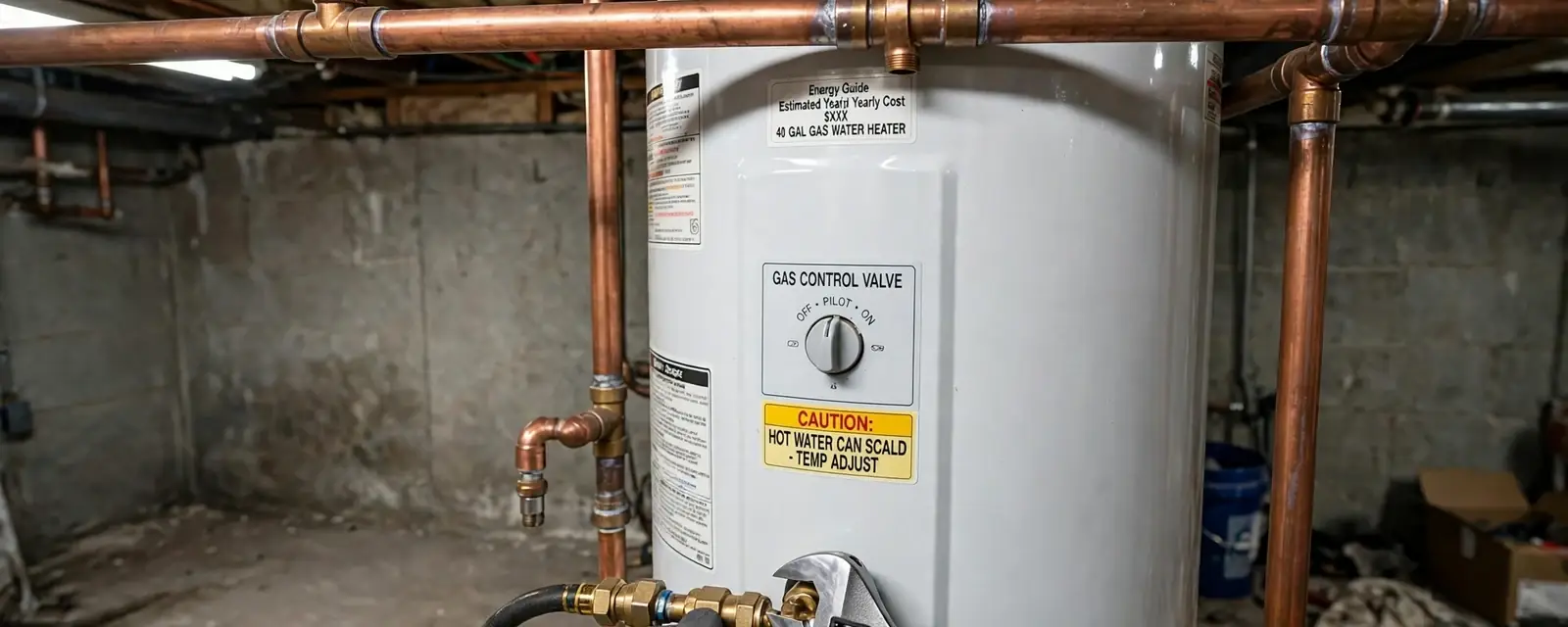
Water heater failing or leaking in Millburn
A water heater that is leaking, popping or smelling of gas is a problem for tonight, not next week. Emergency water heater repair in Millburn, NJ is available 24/7 through the dispatch line. Until a plumber arrives, close the cold water valve above the tank, switch off the breaker or turn the gas control to off, and keep people and pets away from the puddle.
Most calls fall into three groups. The tank or a connection is leaking, the heater runs but the water never gets hot, or something about the burner, the noise or the smell is wrong. Each has a different safe first move, and the sections below sort them out so the right parts are on the truck.
Smell gas? Leave first
If the room smells like gas, do not touch switches or try to relight the pilot. PSE&G says to exit the building right away, move at least 350 feet away, then call PSE&G at 1-800-880-PSEG (7734) or 911. Reporting a gas leak is free. A plumber can look at the heater after the utility has made the area safe.
Water heater leak, and where the water really comes from
A puddle under a water heater is not always a dead tank. The source decides everything, so look before you decide. Dry the floor, then wrap a paper towel around each suspect connection and see which one turns wet first.
| Where it drips | Usual cause | Repair or replace |
|---|---|---|
| Base of the tank or the body seam | Corroded or cracked tank | Replace the unit |
| Pipe connections on top | Loose or worn fitting | Often repairable |
| T&P valve or its discharge pipe | Pressure, heat or a worn valve | Repair, then find the cause |
| Drain valve near the bottom | Worn valve or debris in the seat | Usually a small repair |
| Damp base on a high-efficiency gas unit | Condensation or a clogged condensate line | Clear the line, then recheck |
The T&P valve deserves its own word. It opens on purpose when pressure or temperature climbs too high, so a steady drip can mean a worn valve, or thermal expansion pushing pressure up each time the heater cycles. Never cap the discharge pipe. That valve is the last safety on the tank.
Shutting off water, power or gas
- Close the cold water shutoff on the pipe above the tank. If it will not turn, close the main water valve instead.
- On an electric heater, switch off its breaker at the panel before anyone steps near standing water.
- On a gas heater, turn the gas control knob to off. If you smell gas, leave the house and call PSE&G or 911.
- Move towels or a wet vac toward a floor drain, away from finished floors and outlets.
- Call the 24/7 line and say where the water appears.
A leak that stays within the tank's footprint is the heater. Water on a ceiling below, a wet wall behind the unit or a puddle with no heater nearby can be a supply line instead, and leak detection traces that source.
Leaking tank or no hot water?
Shut the cold supply and the power or gas, then call the 24/7 line. Tell the dispatcher the fuel type and where the water is showing.
No hot water, or only lukewarm
When the heater runs but the water never warms, the cause depends on the fuel. An electric tank often has a tripped breaker, a high-limit reset button that popped, or a failed element or thermostat. A gas tank may have a pilot that went out, a worn thermocouple or a faulty gas control valve. Heavy sediment and a cracked dip tube can also leave a tank lukewarm.
Gas, electric and heat pump tanks fail in different ways
The type of heater changes what breaks and what a repair involves. The data plate on the side of the tank lists the fuel, model and serial number, so read it out when you call at any hour.
Gas tank
A burner, pilot or igniter, thermocouple and gas control valve do the heating, and a flue carries exhaust out. Repairs center on those parts, and any gas smell comes first.
Power-vent gas tank
A fan pushes exhaust through plastic vent pipe and needs electricity. A blocked vent or a failed blower can shut the heater down even when the burner is fine.
Electric tank
Two elements and two thermostats sit behind access panels. One failed element leaves lukewarm water, and scale on an element is a common reason it burns out.
Heat pump tank
Sometimes called hybrid, it moves heat from room air into the tank and keeps backup elements. Trouble often traces to a dirty air filter, a blocked condensate line or a lockout shown as a code.
Hard water in the Short Hills system and what scale does to a heater
NJ American Water's 2025 Annual Water Quality Report for the Short Hills System lists total hardness between 52 and 342 mg/L. The top 2024 result sits above the 250 mg/L secondary limit the report cites, and the report does not say which streets get which number. Your tap can differ from a neighbor's.
Scale is the practical result. Minerals bake onto electric elements until they overheat and burn out. In a gas tank, a layer of sediment on the bottom sits between the flame and the water, which causes popping, rumbling and slower recovery. Scale also clogs the drain valve you would use to flush the tank.
Test your tap. A hardness test strip from a hardware store gives a rough reading, and a lab test gives a firmer number. With that figure a plumber can set a sensible flush schedule. Parts of Springfield appear in the utility's Short Hills system notice, so neighbors across the line should test as well.
Repair or replace, and how to tell
A plumber should tell you plainly whether a repair is worth the money. Age, tank condition and what failed all weigh in.
A repair usually makes sense when
- The leak is at a fitting, valve or pipe connection, not the tank body
- The tank is dry and the failed part is an element, thermostat, thermocouple or valve
- The heater is fairly young with no history of repeated failures
- A code is showing and the part behind it has been identified
A different set of facts points the other way. A tank leaking from its body, rusty hot water that clears only from the hot side, and repeated repairs on an old unit usually mean water heater replacement is the sounder choice. Some homeowners also look at a tankless unit at that point, which changes the gas line, venting and space plan.
What a repair visit covers
Overnight calls follow the same steps as daytime visits. Here is what the plumber does once on site.
Find the fault
Check the power or gas supply, the controls and the true source of any water.
Make it safe
Isolate water, power or gas as the situation requires.
Replace the failed part
Elements, thermostats, thermocouples, T&P valves, drain valves and fittings can often be done the same visit when parts allow.
Flush and test
Flush sediment where the drain valve works, refill, bleed air, then check temperature and every joint.
Explain what comes next
Condition of the tank, the anode rod and a flush schedule that fits your water.
What decides the price of a water heater repair
The repair price is explained before work starts, and it follows what failed and how hard it is to reach.
Homeowner policies often cover sudden water damage from a leaking tank but not the heater itself or damage from slow seepage over time. Check your policy, and take photos of the leak before cleanup.
Call the 24/7 line and the dispatcher will explain the price before any work starts.
Frequently asked questions
Yes. The dispatch line is open 24/7, including nights and weekends. Problems that can wait are handled as same-day appointments when the schedule allows. Tell the dispatcher if water is spreading or you smell gas so the call is handled in the right order.
It depends where the water starts. A leak at the drain valve or a supply fitting can be repaired. Water coming through the tank wall means the steel has failed and the tank needs replacing, so shut off water and power until a plumber arrives.
A drip can mean the valve is worn or that pressure climbs each time the heater cycles. Treat it as a warning. Never plug the discharge pipe, and have a plumber check the valve and the system pressure.
Look at the breaker for an electric unit, and at the pilot or igniter light on a gas unit. If you smell gas, leave the house before anything else. Do not open electrical panels on the tank yourself. If the checks do not help, call the dispatch line.
Flushing sediment from a tank is a standard service, and it matters most where water is mineral-heavy. A tank that is leaking, or a drain valve clogged with scale, may not flush well. A plumber will say whether the tank looks worth saving.
Codes differ by maker, so the model number on the data plate matters. Common causes are ignition or flame trouble on gas units, a blocked vent, a failed sensor, or a heat pump filter or condensate issue. Read the code and model to the dispatcher.
Rarely. Rust streaks, water at the seam and a crusted base mean the tank is failing, and a new valve or fitting will not stop that. Compare it against a replacement before paying for a repair that may not hold.
Scale can, because it coats elements and builds up as sediment. The utility's 2025 report for that system lists a range of 52 to 342 mg/L, so the effect depends on your tap. Test yours and ask a plumber about flushing.
Still have a question? Call the 24/7 line and talk it through with a dispatcher.