
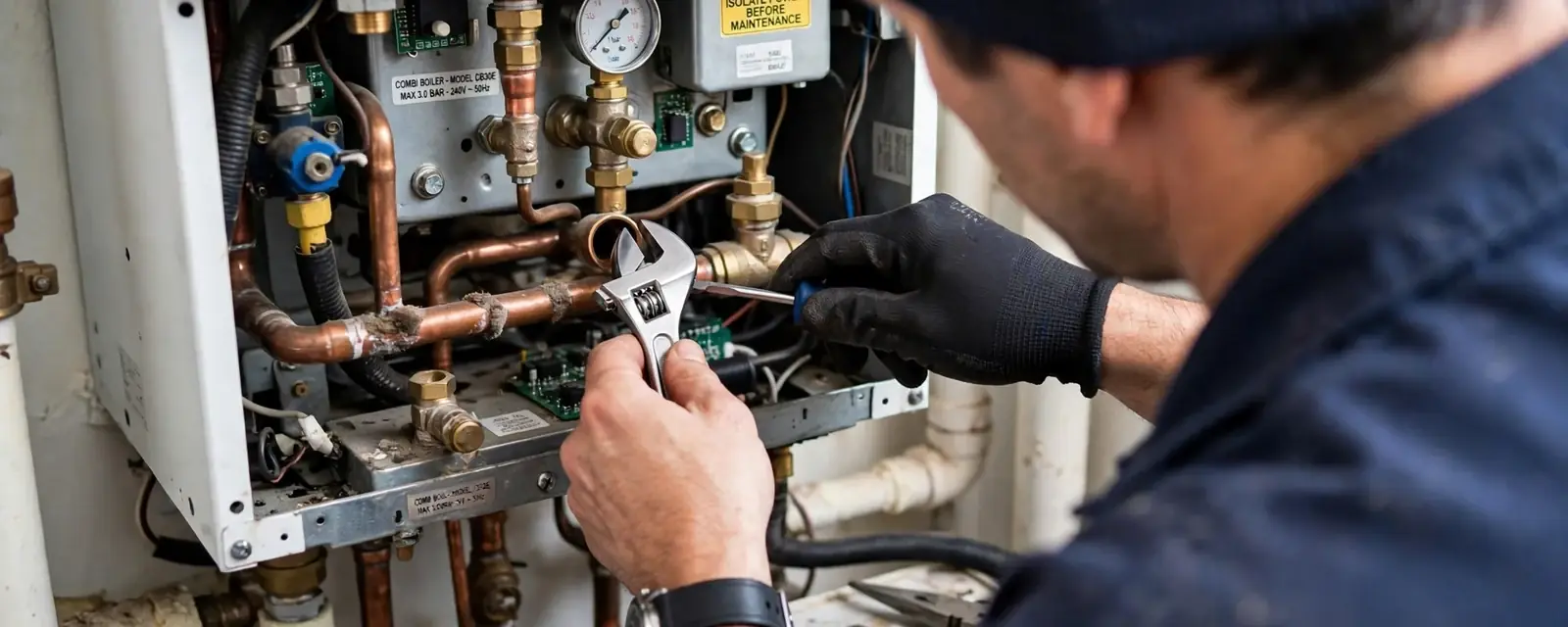
When no heat is an emergency
No heat on a cold night is an emergency in Millburn, NJ, and our 24/7 line takes boiler repair calls at any hour. While you wait, check that the thermostat is set to heat, confirm the boiler's power switch is on, and read the pressure gauge. If you smell gas, leave first and follow the box below.
Smell gas? Leave first.
Exit the building immediately and move at least 350 feet away. Then call PSE&G at 1-800-880-PSEG (7734) or 911. Reporting is free. Do not try to relight or reset the boiler, and call us only after you are safe.
Night, weekend and holiday heating calls are a normal part of the 24/7 line. Nobody can promise an arrival time, so the safe checks below are worth doing while you wait. Same-day repair is offered when the part is available during the visit.
Frozen pipes are the second risk of a dead boiler. If the house is cooling and the outside is cold, open cabinet doors under sinks and let a faucet drip, and read our guide to burst pipe repair in case a line splits.
Hot-water or steam, which system do you have
A hot-water boiler heats water and a circulator pump sends it through a closed loop of pipe to radiators, baseboards or in-floor tubing. A steam boiler boils water, and the steam rises to the radiators, gives up its heat and returns as water. A visible glass tube on the side of the boiler that shows a water level usually means steam.
The difference matters because the faults differ. A hot-water system cares about pressure, a working circulator and trapped air. A steam system cares about its water level, its vents and its controls. Do not add water to a steam boiler yourself.
Cold house and no heat?
Do the safe checks, then call the 24/7 line. A licensed plumber will take it from there.
What you can check safely
Safe checks before you call
- Thermostat set to heat, above room temperature, with fresh batteries if it uses them
- The boiler's power switch and the breaker for the heating circuit
- Pressure gauge reading compared with the range marked on the gauge or in the manual
- Visible water on the floor or at the pipes beside the boiler
- Whether only one zone is cold or the whole house
Write down what you see. The gauge reading, any error light and which rooms are cold help the dispatcher before a plumber arrives.
What you must not touch
Leave these to a licensed plumber
Do not open the burner compartment, adjust the gas valve, cap or plug the relief valve, bypass a safety control or pour water into a hot steam boiler. These parts protect against fire, scalding and explosion.
A carbon monoxide alarm that sounds is a reason to leave and call 911, not to troubleshoot.
No heat, banging and low pressure, what each one points to
| Symptom | Common causes | What to do |
|---|---|---|
| No heat at all | Thermostat, power, tripped safety, ignition fault, failed circulator | Do the safe checks, then call |
| One zone cold | Zone valve, trapped air, closed valve | Call, or bleed a hot-water radiator |
| Banging or knocking | Trapped air, scale in the boiler, water hammer in steam pipes | Call, and note when it happens |
| Low pressure | Leak, failed fill valve, waterlogged expansion tank | Check for leaks, then call |
| Water at the boiler | Failed fitting, relief valve, leaking pipe | Shut the boiler off and call |
| Turns on and off in bursts | Pressure, controls, flue or sizing issue | Call, and note how often |
Scale deserves a mention. The Short Hills water system's own 2025 report lists hardness from 52 to 342 mg/L, so mineral buildup in a boiler depends on your own tap. Tell the plumber if your water leaves white crust on fixtures.
Leaks and relief valve discharge
A boiler that is leaking should be switched off at its power switch, and the water supply to it closed if you can reach the valve. A leak at a fitting, a pump flange or a pipe might be small, but a leak that keeps the pressure low will shut the boiler down. If water is coming from the system, leak detection can trace pipes inside walls or floors.
The relief valve opens to protect the boiler from too much pressure or temperature. A discharge usually points to a waterlogged expansion tank, an overfeeding fill valve or a control that failed to shut the burner off. Never cap the discharge pipe. A valve that drips after it has opened once may also be worn.
Short cycling and bleeding radiators
Short cycling means the boiler fires, shuts off, and fires again within minutes. Causes include a thermostat in a bad spot, a pressure problem, a dirty burner and a boiler too big for the loads it serves. It wears parts quickly, so it is worth a call.
A hot-water radiator that is warm at the bottom and cold at the top has air in it. With the boiler off and cool, open the bleed valve with a radiator key over a cloth until water spits steadily, then close it and check the gauge. Steam radiators use air vents, not bleed valves, so leave those alone.
Annual service is planned work
Servicing a boiler once a year is planned work, scheduled outside the cold weeks. The plumber checks the burner, controls, safeties, pressure and venting, and flushes or tests the water as needed. It catches small faults before they become a January no-heat call.
If a hot-water zone needs new piping, a new radiator or a bathroom addition, see plumbing installation. If the same visit finds trouble with the tank, water heater repair covers it. Dispatch also reaches Summit and the towns around Millburn.
What shapes the price of a boiler repair
The price depends on what failed and whether it can be fixed on the first visit.
Homeowner insurance often does not cover a boiler failure from wear, but may cover sudden water damage from a leak. Check your policy.
Call for a clear price before work starts.
Frequently asked questions
Yes. The 24/7 line is answered at any hour, including nights, weekends and holidays, and a licensed plumber is dispatched. Nobody can promise an arrival time, so do the safe checks while you wait.
Check that the thermostat is set to heat, the boiler's power switch and breaker are on, and the pressure gauge is in the marked range. Also note whether the whole house or one zone is cold.
Leave the building immediately, move at least 350 feet away, and call PSE&G at 1-800-880-PSEG (7734) or 911. Reporting is free. Repairs follow once the utility has cleared the scene.
In a hot-water system it is often trapped air or scale. In a steam system it is often water hammer from condensate caught in a pipe. A plumber can tell which.
The valve opened because the pressure or temperature got too high. A waterlogged expansion tank is a common cause. Do not cap the pipe, and call for a repair.
On a hot-water system with bleed valves, yes, with the boiler off and cool. Steam radiators have air vents instead, so leave them alone.
Annual service is planned work that checks the burner, controls and safeties before cold weather. It is the best way to avoid a winter no-heat call.
Still have a question? Call the 24/7 line and talk it through with a dispatcher.