
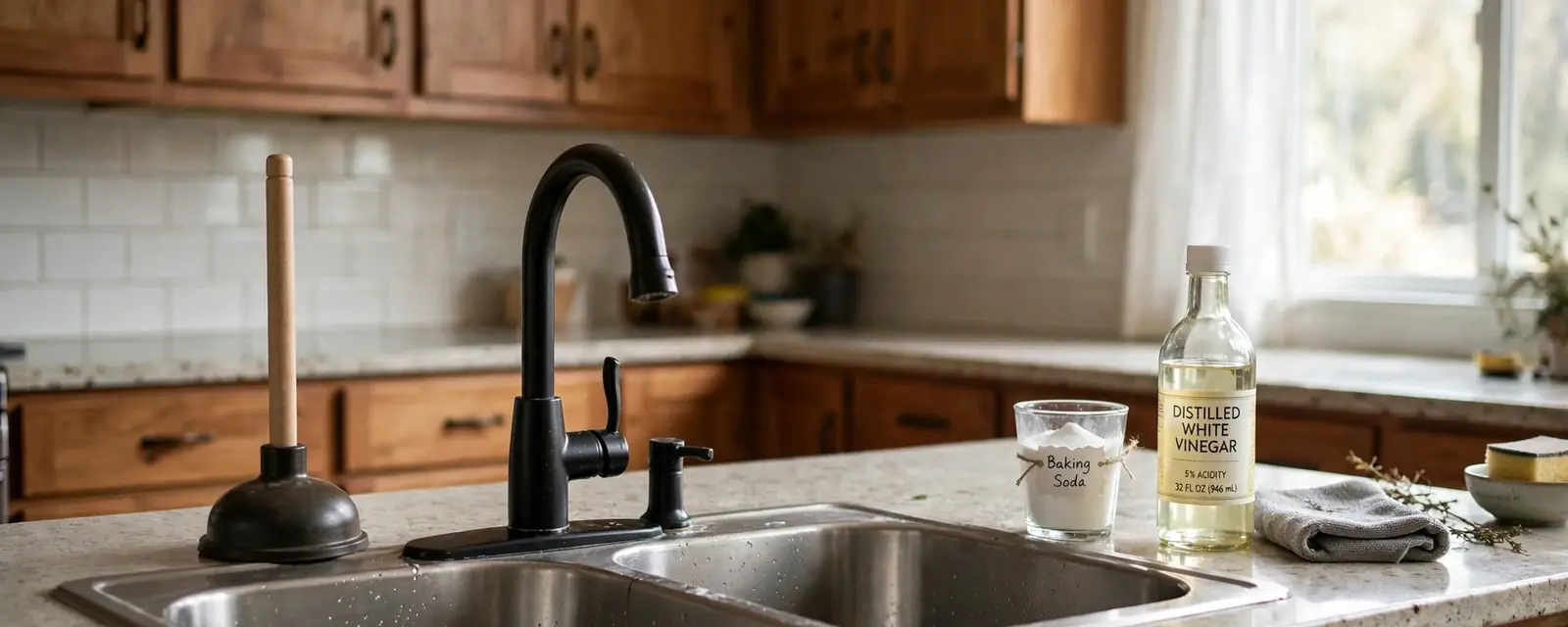
Does vinegar and baking soda really clean a drain?
Vinegar and baking soda drain cleaning in Millburn, NJ kitchens and bathrooms works as a light freshening treatment, not as a clog remover. The fizz loosens a thin film of soap and grease near the drain opening and takes the edge off odors. It will not dissolve a hairball, break up a wad of paper, or push through roots in a sewer line.
Treat it as maintenance. When water stands in the sink or tub for more than a few minutes after you stop the tap, you are past what a kitchen-cupboard remedy can handle, and a licensed plumber should look at the line.
The chemistry is simple. Baking soda is sodium bicarbonate, a mild base, and white vinegar is dilute acetic acid. Together they release carbon dioxide gas and leave mostly salty water behind, so the bubbling looks dramatic but the force is small and most of it rises back out of the drain.
What the fizz does and does not do
It loosens soap film
A thin coat of soap scum and body oil near the stopper softens, and a hot water rinse carries some of it past the trap.
It takes the edge off odors
Vinegar cuts the sour smell that builds up on the drain wall just below the opening, which is why it feels like it worked.
It does not dissolve hair
Hair wrapped around a pop-up stopper or caught in a trap is protein, and mild acid and base do very little to it.
It does not reach past the trap
A grease plug, a paper wad or a root intrusion sits farther down the line, and the foam never gets there with any strength.
Safe steps for a mildly slow drain
Clear the opening first
Lift the stopper or strainer and pull out visible hair and gunk by hand with a glove, or with a plastic barbed drain tool.
Rinse with very hot tap water
Run the hot tap for a minute. Skip boiling water, which can crack porcelain and soften plastic fittings.
Add the baking soda
Pour about half a cup down the drain and let it settle toward the trap.
Follow with the vinegar
Pour in about a cup of white vinegar and cover the opening loosely with a plug or damp rag so more of the fizz works downward. Never seal it tight.
Wait, then flush
Give it about fifteen minutes, then run hot tap water for a minute or two and watch how fast the basin empties.
Never mix it with a chemical drain opener
Do not pour vinegar into a drain that already holds a commercial opener, and never follow a bleach or lye product with an acid. Vinegar and bleach can release chlorine gas, and an acid meeting a strong base generates heat that can spit out of the opening.
If a chemical opener is sitting in a standing sink or tub, do not plunge it and do not add anything. Open a window, keep your face away, and call a licensed plumber so the next person opening the trap knows what is in it.
Drain still slow after the fizz?
Call the 24/7 line and a licensed plumber can find where the line is actually blocked.
Why it fails on a real clog
Real clogs are mechanical. Hair knits itself around the pivot rod of a bathroom stopper, congealed cooking fat narrows a kitchen branch line, and wipes or paper catch on a rough pipe joint. None of that responds to a short burst of foam.
The remedy also arrives diluted. If water is already standing in the basin, the vinegar and baking soda mix into the pooled water and spend their reaction before reaching the blockage.
A plumber doing drain cleaning uses a cable or auger that physically grabs or breaks up the obstruction, then flushes the line. Where grease or scale has coated the pipe wall over the years, hydro jetting sends pressurized water around the full inside of the pipe to scour it clean, which a home remedy cannot do.
Signs it is more than a surface film
- Water stays in the sink or tub well after you shut off the tap
- A gurgle from a toilet or tub when the sink drains
- More than one fixture draining slowly
- A sewage smell that comes back after you rinse
- The same drain clogging again within days of treating it
Match the problem to the fix
| What you notice | Vinegar and baking soda | Better move |
|---|---|---|
| Faint odor from a bathroom sink | Reasonable to try | Also clean the stopper and overflow opening |
| Slow kitchen sink, greasy water | Limited help | Hot water with dish soap, then call if no change |
| Standing water in a tub | Will not help | Pull hair at the drain, then call |
| Gurgling in several fixtures | Will not help | Call, since the main line or a vent may be involved |
| Repeat clog every few weeks | Only hides it | Have the line cleared and inspected |
Where to draw the line at home
The safe DIY part is small. Pull the visible debris, rinse with hot tap water, and try the fizz once or twice for odor. Taking apart a trap is possible for a handy homeowner, but do it with a bucket and expect a messy few minutes.
Anything that involves cutting, replacing or reconnecting pipe is a different matter. Permit rules vary, so ask the Millburn building department before you open walls or swap piping, and keep in mind that a home method is not a code-compliant repair.
The advice is the same on either side of the township line. Households in Springfield and Livingston are tempted by the same remedy, and the pattern repeats. It handles a smell, but a drain that keeps slowing needs the pipe itself cleared.
What changes the cost of a professional clearing
- Where the blockage sits, since a stopper-level clog is simpler than one in a branch or main line
- The fixture involved, because a kitchen line with grease behaves differently from a bathroom sink
- Whether the line needs a camera inspection to find the cause
- Whether cable clearing is enough or the pipe wall needs scouring
- Access to the cleanout or trap, and whether a fixture has to be pulled
- Evening or weekend dispatch compared with a same-day daytime visit
A plumber can give you a clear price before work starts once the line has been looked at, so the number reflects your pipe rather than a guess.
Millburn, NJ: reading your water report when drains keep slowing
NJ American Water customers in Millburn and Short Hills can find their annual water quality report on the utility's website, under the Water Quality tab, by searching their ZIP. You can also call 800-272-1325 and ask for it. The report lists total hardness, which is the number that explains most mineral scale.
Hard water leaves a chalky crust around a drain flange, and that crust is what vinegar actually dissolves well on a fixture surface. Scale inside a line is a different problem, because a thickened inner wall narrows the pipe and gives hair and grease something to catch on. A fizz at the opening cannot reach it.
The takeaway is to read the hardness line on your report and look at your drain flange. If you see heavy white crust and the same drain keeps slowing, ask a plumber to look inside the line instead of repeating the home remedy.
Source type: NJ American Water annual water quality report
Frequently asked questions
Occasionally is fine, for example when an odor shows up. It is not a schedule that prevents clogs, and a drain that needs it every week has a real problem behind it.
The mixture itself is mild and generally safe for household pipes. The risk comes from boiling water, which can soften plastic fittings, so use very hot tap water instead.
Older metal pipes can have scale or corrosion you cannot see, so a drain that keeps backing up is worth having checked.
No. Mixing vinegar with bleach products can release chlorine gas, and acid meeting a strong base can heat and spatter. Leave the sink alone, ventilate, and call a plumber.
No. A toilet clog is usually paper or a solid object in the trapway, and foam does not move it. A flange plunger is the right home tool, and a plumber can handle a clog that a plunger will not clear.
The fizz can stir up film that was sitting on the pipe wall, so a short-lived smell is possible. If the odor stays, the cause is often a dry trap, a dirty overflow opening, or buildup farther down the line.
Millburn 07041 and Short Hills 07078 customers of NJ American Water can search by ZIP under the Water Quality tab on the utility's site, or call 800-272-1325. Look for the total hardness result and compare it with the crust you see on your fixtures.
Still have a question? Call the 24/7 line and talk it through with a dispatcher.