
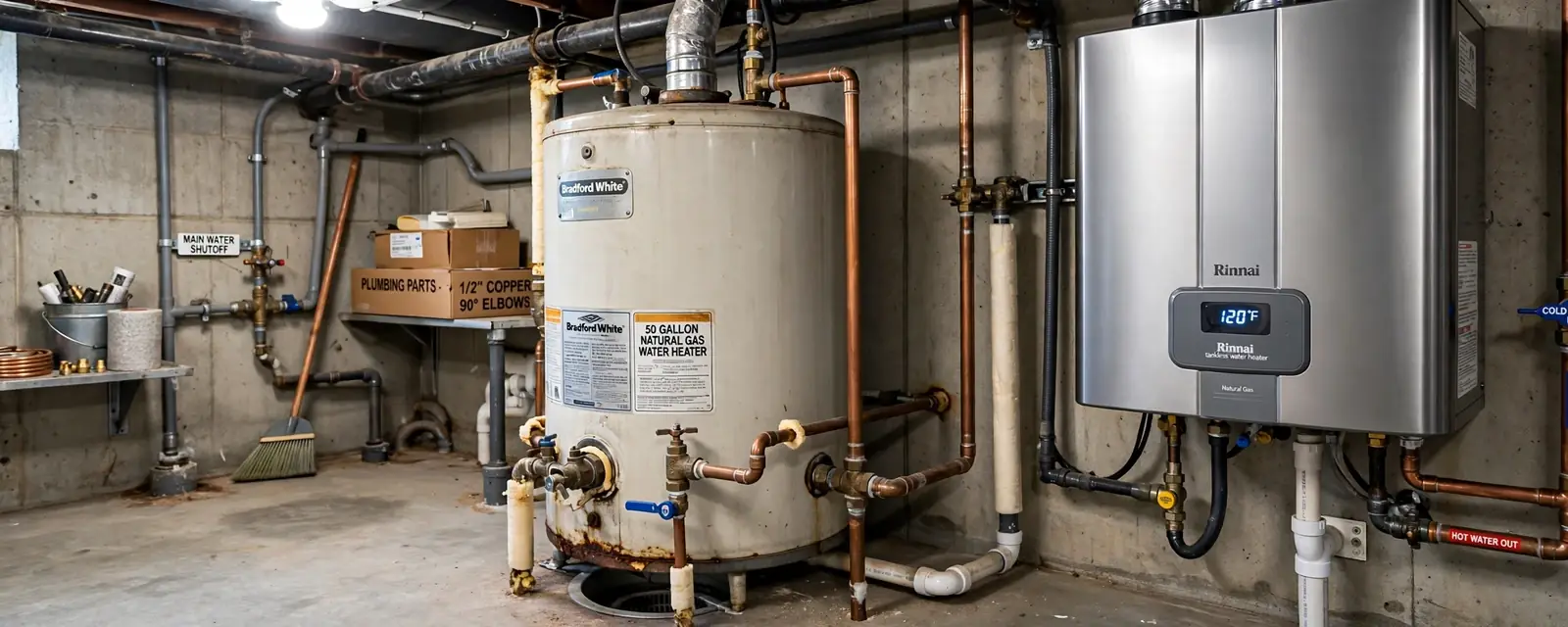
Why a tankless swap is more than a swap
Tankless water heater replacement cost in Millburn, NJ depends on what has to change around the unit, not the unit alone. A tank stores hot water and fires slowly, while a tankless heater makes it on demand with a much larger burst of energy. That demand reaches back into your gas line, your vent, your electrical supply and your drains.
Know those areas and a quote becomes readable. They are listed below in the order that tends to surprise homeowners most.
Gas line size
Why the line matters
A tankless burner can draw far more gas at one moment than a tank burner. The line feeding it has to carry that load alongside the furnace and the stove.
What a plumber checks
Pipe diameter, the length of the run from the meter, and the combined load of every gas appliance determine whether the old line is enough or needs upsizing.
Upsizing the line is not always a small job. A longer run through finished walls or a basement ceiling means more pipe, more fittings and more access work, and the gas meter and regulator may be part of the conversation with the utility. A licensed plumber sizes the line from the manufacturer's input rating and the run, and tests it for leaks before the unit is lit.
If you ever smell gas, leave the building immediately, move at least 350 feet away, and call PSE&G at 1-800-880-7734 or 911.
Venting is a different system
Most tankless gas units are high-efficiency condensing models, and they vent through plastic pipe, typically out a side wall, instead of through an old metal flue or chimney. Non-condensing units need stainless or specially rated vent material.
The old flue from the tank heater usually cannot be reused as it is. Where it was shared with a furnace or a boiler, removing the tank can leave the other appliance venting into an oversized flue, which a licensed plumber needs to address.
Electrical supply
A gas tankless unit still needs power for its fan, controls and ignition, so an outlet or a hardwired connection has to be near the heater. An electric tankless unit demands a very large amount of current, and some houses need panel work to support it.
Ask whether the quote includes the electrical work, and whether a separate licensed electrician is involved. Do not leave it as an unknown.
Thinking about tankless?
Call the 24/7 line and a licensed plumber can check your gas, vent and drain routes before you price it.
Water treatment and scale
A tankless heat exchanger has narrow passages that scale can clog. Isolation valves with service ports let a plumber flush the unit with a descaling solution, and some makers recommend a scale-control cartridge in hard water. Those parts add to the first cost but cut maintenance trouble later.
Ask which water treatment the maker's warranty expects, and whether the flush routine is something you will do or something you will schedule with a plumber. Either answer is fine, as long as it is decided before the unit goes on the wall.
Condensate drain
A condensing unit produces acidic condensate as it cools exhaust gas, and that liquid has to drain somewhere safe. A floor drain, a laundry standpipe or a condensate pump can work, and a neutralizer cartridge is sometimes used. A basement without a nearby drain can add pipe or a pump to the job.
When tankless does not make sense
A tankless unit is a poor fit when the gas line cannot be upsized without opening large sections of finished wall, when no wall route exists for the vent, or when the household will not keep up with flushing. In those cases the money is better spent on a quality tank, an expansion tank and good venting.
The flow limit also matters. A tankless heater raises the temperature of water as it flows, so a long shower, a running washer and a dishwasher all drawing at once can exceed its capacity. Think about your busiest morning, and ask the plumber what the unit delivers at that load.
Tank or tankless, side by side
| Question | Tank heater | Tankless heater |
|---|---|---|
| Hot water supply | Limited by tank size | Continuous, up to the flow limit |
| Gas line and vent | Often reused | Often upsized and re-run |
| Electrical | Little or none for gas | Outlet or circuit needed |
| Space | Floor space for the tank | Wall mount, smaller footprint |
| Maintenance | Tank flush, anode rod | Scheduled descaling flush |
| Drain | Relief valve discharge | Relief and condensate drains |
When tankless makes sense
Good fits
- A tank running out of hot water and little room for a larger one
- A basement or utility wall with a clear route for a side-wall vent
- A home with a gas line that can be upsized without major wall work
- A household willing to schedule flushing
- A family that wants the ability to run several fixtures at once, within the unit's flow limit
For a proven fit, tankless water heater work starts with a survey of the gas, vent and drain routes. If the tank is failing today and the space makes tankless hard, water heater replacement with a new tank may be the wiser fix.
What the replacement looks like
Survey the routes
A plumber checks the gas load, vent path, power and condensate drain before any price is set.
Remove the tank
The old heater is drained, disconnected and taken out, and the old flue is dealt with.
Run gas, vent and drain
New pipe, vent and drain connections go in, and isolation valves are fitted for later flushing.
Mount and connect
The unit is mounted on the wall, connected to water, gas and power, and tested for leaks.
Commission and explain
Settings are checked and the flush schedule is explained.
Questions that shape the quote
- Gas line upsizing and how far the run is
- Vent path and whether a wall penetration is needed
- Electrical outlet or panel work
- Scale control and isolation valves
- Condensate routing and neutralizer
- Permit and inspection steps, which vary, so ask the Millburn building department
Homes in West Orange and Springfield come in many styles, so the answer to each question changes with the layout. The right quote is the one written after someone has looked at your gas meter, your basement wall and your drain.
Millburn, NJ: hard water and the flush schedule
The utility's own 2025 water quality report for the Short Hills System lists total hardness across a range of 52 to 342 mg/L. The report does not say which streets receive which value, so your tap can differ from your neighbor's.
That matters more for tankless than for a tank, because scale collects in the narrow heat exchanger and cuts flow and efficiency. Harder water generally calls for more frequent flushing than softer water, so follow the maker's schedule and tighten it if your water runs hard.
The takeaway is to test your tap before you buy. Ask the installer for isolation valves with service ports, and put the flush on your calendar the day the unit is commissioned.
Source type: NJ American Water 2025 annual water quality report
Frequently asked questions
Sometimes, but often it needs upsizing. A plumber measures the pipe, the run length and the total appliance load to decide.
Makers often rate them for a longer life, but that depends on regular flushing and your water. Hard water and skipped maintenance shorten it.
Only if gas, vent, power and drain routes can reach that spot. Many installs relocate the unit to a wall with a clear vent path.
Yes in most homes. Scale builds up in the heat exchanger, and an annual flush through isolation valves is common practice, with more frequent service in harder water.
Not by tank size, but a tankless unit has a flow limit. Running too many fixtures at once can still exceed it.
The NJ American Water 2025 report for the Short Hills System lists 52 to 342 mg/L, so your tap may vary. It matters because scale builds up in a heat exchanger. Test your tap and plan the flush.
Still have a question? Call the 24/7 line and talk it through with a dispatcher.