
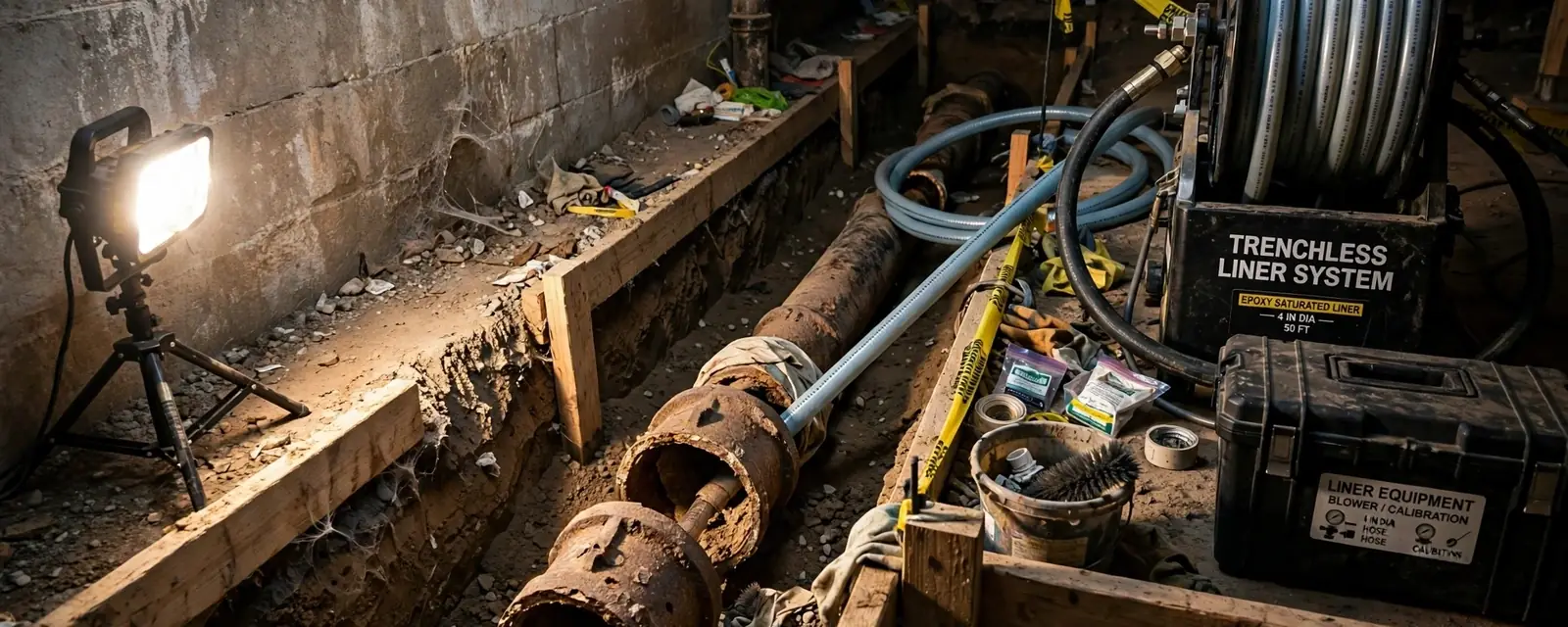
Pipe lining, spot repair or replacement at a glance
Pipe lining cost in Millburn, NJ depends mostly on how long the pipe is, how wide it is, how easy it is to reach and how much cleaning it needs first. Lining suits pipes that are cracked, leaking at joints or damaged by roots but still hold their shape. It does not suit pipes that have collapsed or sagged.
| Pipe condition | Best fit | Why |
|---|---|---|
| Hairline cracks or leaking joints, pipe still round | Lining | A new pipe forms inside the old one without digging. |
| One broken or offset section | Spot repair | Replacing a short section can cost less than lining the run. |
| Collapsed or crushed pipe | Replacement | A liner needs an open path to pass through. |
| Low spot that holds water | Replacement or spot repair | A liner follows the pipe, so it keeps the sag. |
| Roots entering at several joints | Cleaning, then lining | Lining after cutting roots can seal the entry points. |
| Pipe shape or route unknown | Camera first | The inspection decides all the other choices. |
What does a pipe liner actually do?
A liner is a flexible tube soaked in resin. It is pulled or inverted into the old drain, pressed against the walls and cured until it hardens. The result is a pipe inside a pipe, with no joints for roots to enter and no cracks for water to leave.
Before any of that, the pipe has to be cleared. Roots, scale and grease are cut or jetted out, and a camera confirms the pipe is clean enough to line. Skipping that step is how a liner ends up wrinkled or blocked.
How a lining job runs
Inspect
A camera runs through the pipe to measure the length, find the damage and check the shape.
Clean
Roots, scale and grease are cut or jetted out so the liner can sit tight against the pipe wall.
Insert the liner
The resin-soaked tube is pulled or inverted into place through a cleanout or a small access opening.
Cure
The liner is pressed against the wall and hardened, often with heat or light.
Reopen and verify
Side connections are reopened and a final camera pass checks the result.
Slow drains, roots or a cracked line?
Call the 24/7 line and a licensed plumber can run a camera and tell you whether lining is realistic.
What lining can fix
- Hairline and longitudinal cracks in clay, cast iron or other drain pipe.
- Leaking joints where one pipe section meets the next.
- Root intrusion, once the roots have been cut back.
- Rough, scaled pipe walls that snag paper and grease.
- Long runs under a driveway, patio or finished landscaping that nobody wants to dig up.
A liner also keeps digging to the entry and exit points, which matters when the pipe runs beneath mature trees or hardscape.
What lining cannot fix
A liner cannot rebuild a pipe that has fallen in. It also cannot level a belly, which is a low spot where water sits and solids settle. Missing pieces, severely displaced joints or a broken section that blocks the liner's path all need digging first. Lining also trims the inside diameter slightly, so the new pipe is a little narrower than the old one.
Camera before cost
Nobody can price lining honestly without seeing the pipe. A sewer inspection with a camera shows the length, the damage and whether lining is even possible.
Lining, spot repair and replacement in plain terms
Spot repair
When the camera shows one bad section and the rest of the pipe is healthy, cutting out the damaged piece and replacing it can be the sensible fix. It needs a hole at that spot, so depth and surface matter.
Lining
When damage is spread along the pipe and the pipe is otherwise continuous, lining treats the whole stretch at once and limits digging to access points. It keeps the existing route, so a pipe laid with a dip stays dipped.
Full replacement
When the pipe has collapsed, sagged or broken in several places, replacing the run is the only way to restore slope and strength. It costs the most disruption, and it is sometimes the only answer that lasts.
What decides the price
Lining has a lot of moving parts, and these are the ones that change a price most.
Homeowner policies often cover sudden damage but usually not wear, age or root intrusion in a drain line, though some offer a sewer line endorsement, so check your policy.
Call the 24/7 line, describe what your drains are doing, and a clear price comes before work starts.
Which part of the line is yours?
Ownership decides who can repair or line a pipe, and it varies by town and sometimes by property. Before approving any lining, ask your municipality which stretch of the sewer lateral you own and where the town's responsibility begins. A plumber can line your side but not a pipe you do not own.
For repair or replacement work on the owner's side of a sewer or drain, sewer line repair is the service to ask about. The order is a camera first, then a choice between lining, a spot fix and a full run.
What this means near Millburn
Houses vary, so pipe material does too. In West Orange, housing runs from Victorian and Tudor to post-war homes, and in Livingston the age and material depend on the individual house. Neither town tells you what is under your lawn. Only a camera does.
Millburn, NJ: which side of the service line you own
NJ American Water began its Lead Service Line Replacement Program in Millburn in August 2024. The utility owns the water service line from the main to the curb stop, and the property owner owns the rest from the curb stop into the building.
If the owner's section is lead or galvanized, the company says it will work with the owner to replace it at no direct cost, with the cost recovered through a charge on water bills.
Here is the lesson for lining. Ownership splits at the curb stop, and a liner only ever applies to the owner's side. Lining also applies to drain and sewer lines in most cases, not to a pressurized water service line, so ask before assuming. An owner who replaces their own portion with a private contractor pays for it and should contact the company beforehand.
Source type: NJ American Water Lead Service Line Replacement Program
Frequently asked questions
In most cases lining applies to drain and sewer lines, not a pressurized water service line, so ask first. NJ American Water's program owns the main to the curb stop, and the owner owns the rest. If your side is lead or galvanized, the company says it will work with you, so contact it before hiring your own contractor.
A camera inspection shows the length, the shape and the damage. Lining works on pipes that are cracked or leaking but still round and continuous.
It seals the joints and cracks roots use to get in, which removes the entry points. Roots can still press against the outside of the pipe, but they cannot enter a sealed liner.
Any pipe can clog from grease, wipes or other debris. A smooth liner usually sheds waste better than a rough old pipe, but it needs the same care.
Not always. A short, shallow repair can cost less to dig, while a long or hard-to-reach run often favors lining. Access and length decide it.
Permit rules vary, so ask the Millburn building department before work on a sewer or drain line, and ask about ownership of the section involved.
Still have a question? Call the 24/7 line and talk it through with a dispatcher.