
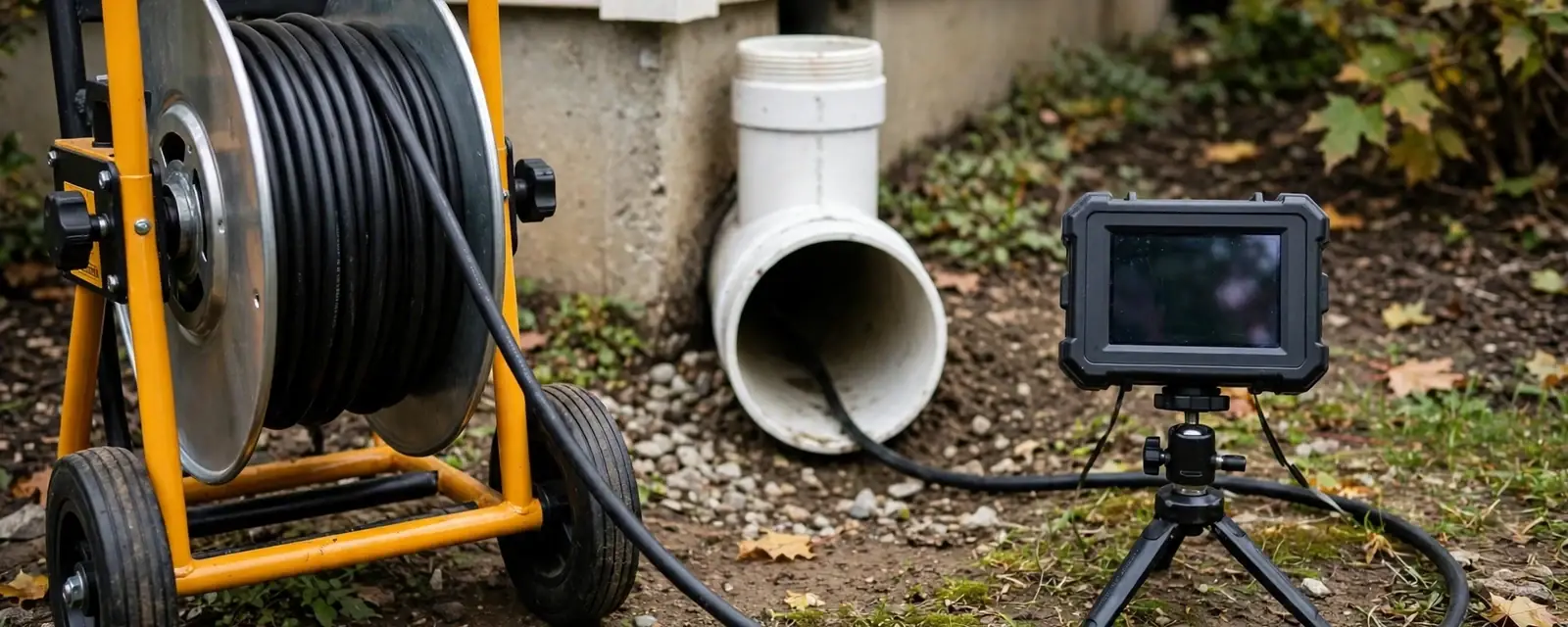
What a sewer camera inspection shows
A sewer camera inspection in Millburn, NJ sends a small waterproof camera through your sewer line and shows the pipe from the inside. You see the material, the joints, any cracks or gaps, roots, buildup, low spots that hold water and the place where the line meets the street connection.
It answers questions no one can settle from the surface, such as whether the pipe is cast iron, clay or plastic, whether a clog is a one-time event or a sign of damage, and whether lining is even possible. The answers turn a guess into a plan.
What the camera can reveal
- Pipe material and approximate condition
- Cracks, breaks and offset joints
- Roots entering at joints
- Grease, scale or debris coating the walls
- Sags or bellies that hold standing water
- Collapsed or crushed sections
When to book an inspection
The best time is before a problem forces your hand. Buyers of older homes in Millburn, Short Hills and nearby towns such as Summit often want to know the condition of the line before closing, because a sewer repair can be a large cost that is easy to avoid by learning about it first. The same logic applies if you inherit or take over a property.
Book one after repeated clogs in the same line, after a backup has been cleared, or when slow drains show up in several fixtures. A line that was cleaned but never looked at can fail again for the same reason. After a flood or heavy storm, a look confirms nothing shifted.
Ask for the footage
Ask that the findings are shown to you and explained in plain words, with any damaged sections pointed out. That is what lets you compare repair options later.
See the pipe before you decide.
Call to schedule a camera look and ask for the findings in plain words. You will know what to clean, line or repair.
How the visit works
Find the way in
The camera enters through a cleanout. If the house has none, the plumber may use a roof vent or pull a toilet.
Clear what is in the way
A heavily clogged line may need cleaning before the camera can pass, which is why cleaning and inspection are often done together.
Run the camera
The plumber feeds the cable toward the street, watching the screen for defects and noting where each one sits.
Locate the problem
A locator at the surface can mark the depth and path of the line above ground, which helps plan any digging.
Talk through the findings
You see what the camera saw, and the plumber explains what it means and what can wait.
Reading the findings
| What the camera shows | What it usually means | Usual next step |
|---|---|---|
| Light grease or scale | Normal buildup in a working line | Cleaning |
| Roots at a joint | Joint is open and roots will return | Cut roots, then line or repair the joint |
| Hairline crack | Early damage, pipe may still hold | Monitor, line or spot repair |
| Offset joint | Two pipe sections have shifted | Spot repair, sometimes lining |
| Sag holding water | Low spot where solids settle | Repair or replace that section |
| Crushed or collapsed pipe | Flow is restricted or stopped | Replace the section |
A single finding is rarely a verdict. Ask whether the problem is localized or runs along the line, whether it is getting worse and what happens if you wait.
What a good report includes
Whatever is written down should let a second plumber understand the line without a second visit. Ask for these items.
- The address and the date of the inspection
- The pipe material and size where it could be seen
- The location of each defect measured from the cleanout or a reference point
- A plain description of each finding
- The recommended next step for each one
- Whether any section could not be inspected and why
A report that says only that the line looks fine is not enough. A line that cannot be passed by the camera is a finding in itself.
What happens next
The result usually points to one of four paths. A line with buildup and no damage gets cleaned through sewer line cleaning, sometimes with hydro jetting. A line with a localized defect gets a spot repair or a liner, and a line with long runs of damage may need replacement. Many lines need nothing but a record that they are sound.
When the camera finds damage, the next conversation is sewer line repair, including the options and their limits. Having the findings in hand means you are choosing between methods and not guessing at them.
What changes the price of an inspection
The price depends on what it takes to get the camera into the line and how much there is to review.
Homeowner insurance usually does not pay for a routine inspection, though a claim for sudden damage may involve one. Check your policy.
Call to schedule a visit, and the price is explained before the work starts.
Frequently asked questions
It depends on the length of the line, how easy the access is and whether cleaning has to come first. A plumber can give a rough idea after hearing about your property.
We do not promise a set time.
They are different but often done together. The camera shows the inside of the pipe, and a locator at the surface marks where the pipe runs and how deep it is.
Ask for both if you are planning any digging.
No. If the line is packed with debris, it must be cleared enough for the camera to pass. Otherwise the image stops at the blockage.
That stopping point is useful information, but it is not a full inspection.
It is a sensible step, because the sewer line is out of sight and repairs can be costly. A camera look shows the material and the condition, and you can negotiate or plan with that information.
Ask the seller for access to the cleanout before you schedule.
A camera on a flexible cable is far gentler than pressure cleaning. Very fragile or collapsed pipe can still be disturbed, so tell the plumber what you know about the line.
If a section is too fragile to pass, that is a finding in itself.
No. One clog in one fixture is usually a cable job. Repeated clogs, several slow drains or a past backup are the reasons to look.
Drain cleaning covers the single-fixture case.
Still have a question? Call the 24/7 line and talk it through with a dispatcher.