
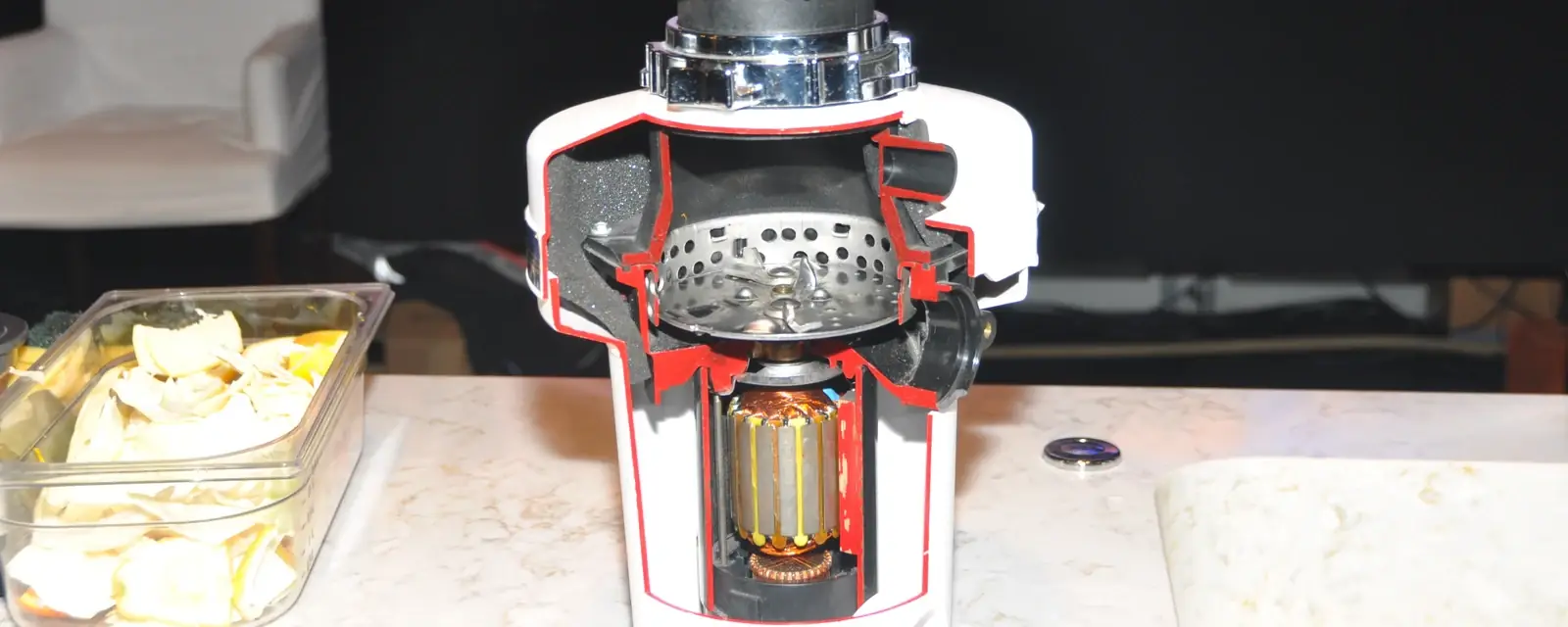
Disposal jammed or leaking under the sink
A disposal that is jammed, leaking or standing full of water is a garbage disposal repair call in Millburn, NJ, and the 24/7 dispatch line is open for it. Turn the disposal off at the wall switch, then switch off its breaker or unplug it, and keep your hands out of the chamber. If water is escaping, close the stops under the sink and put a pan beneath the unit.
Same-day appointments are available when the schedule allows, and a leak that is spreading across the cabinet floor gets treated as an after-hours priority. Tell the dispatcher where the water shows up and whether the sink is draining at all.
Power off before anything else
Never put a hand or a tool into a disposal with the power on. A wall switch is not enough on its own, because someone can flip it. Cut the breaker or unplug the unit, then work from the top with a spoon handle or from the bottom with a hex key.
Why a disposal hums, jams or goes silent
A hum with no spinning means the motor is working but the flywheel is stuck, usually on a fruit pit, bone, utensil or a mass of fibrous peels. A silent unit is often a tripped reset button on the bottom of the housing, or a power supply problem. Both are common calls.
Kill the power
Switch off the breaker or unplug the unit before touching anything.
Free the flywheel from below
Fit a hex key into the socket in the center of the bottom plate and work it back and forth.
Clear the chamber from above
Use tongs or a spoon handle to remove what jammed it, never your fingers.
Press the reset button
The small red button on the bottom pops out when the motor overheats.
Test with water running
Restore power, run cold water and switch it on. Call if it hums again.
If the hex key will not turn or the motor keeps tripping, the bearings or the motor may be failing. Repair stops being practical at that point, and the question becomes replacement.
Where the leak is coming from
| Leak location | Likely cause | Usual fix |
|---|---|---|
| Top, at the sink flange | Loose mounting ring or worn plumber's putty or gasket | Reseat the flange |
| Side, at the drain connection | Failed gasket or loose discharge tube | Tighten or replace the gasket |
| Dishwasher hose port | Loose clamp or cracked hose | Re-clamp or replace the hose |
| Bottom or body of the housing | Cracked casing or failed internal seal | Replace the disposal |
A leak from the body almost always means replacement, because the casing cannot be sealed from the outside. Flange and drain connection leaks are repairs. Dry the unit, run water and watch where the first drops appear, since a wet bottom can hide a leak that started higher up.
A leak that seems to come from the disposal may actually start at the faucet above it. Check the supply connections under the sink before blaming the unit, and see our faucet repair page if the faucet is the source.
Disposal dead, humming or dripping?
Cut the power, close the stops if it is leaking, and call the 24/7 line. A licensed plumber can free it, reseal it or replace it.
Repair or replace the disposal
A jam, a loose flange or a bad gasket is worth repairing. A motor that hums and trips the reset repeatedly, a rusted housing or a leak through the body is the point where replacement is cheaper than another visit. Age matters too, since an old unit with a worn motor tends to fail again soon after a repair.
Signs replacement makes more sense
- Leak from the body of the housing
- Motor trips the reset repeatedly
- Hex key spins freely with no resistance
- Heavy rust or cracks on the casing
- Repeated jams on an old unit
Installing a new disposal
Replacement means removing the old unit from the mounting ring, checking the flange and putty seal, wiring or plugging in the new unit and reconnecting the discharge tube. If the sink also feeds a dishwasher, the knockout plug inside the new unit's dishwasher port has to be removed before the hose goes on. Missed knockout plugs are a classic reason a dishwasher drains badly after an install.
A larger motor needs a solid mounting and the right fit under a shallow sink. Wiring should match the unit's rating, and permit rules vary, so ask the Millburn building department before a first-time hardwire installation.
When the sink clogs and the disposal is involved
A kitchen sink that will not drain after the disposal runs is usually a clog in the trap or the line beyond it, not a failing motor. Grease, coffee grounds and starchy foods build a plug that the disposal cannot grind away. Our drain cleaning service clears the trap and branch line, and the disposal then gets a test with water running.
What affects the price of a disposal repair
Disposal costs split into a small repair and a full replacement.
Homeowner policies often cover sudden water damage from a leaking disposal but may not cover the unit itself or wear and tear, so check your policy.
Call the 24/7 line and you will hear a clear price before work starts.
We take disposal calls in nearby Livingston as well. A faulty disposal and a failing sink drain often get fixed in the same visit when parts allow.
Frequently asked questions
Yes. The dispatch line runs 24/7, so a leaking or jammed disposal at night is a normal call. Turn the power off, close the stops if water is escaping and tell the dispatcher what you see.
Only with the power fully off at the breaker or unplugged. The hex key goes into the socket in the center of the bottom plate and turns the flywheel by hand. Never reach into the chamber, even if the switch is off.
The flywheel is stuck, often on a bone, a utensil or fibrous peels. Cutting the power and turning the flywheel from below with a hex key frees most jams. If it hums again after that, the motor may be wearing out.
A leak at the top points to the sink flange. At the side, the drain connection or the dishwasher hose is more likely. Water from the bottom or body usually means a cracked casing, which calls for replacement.
A dishwasher drain line needs an air gap or a high loop, so wastewater cannot flow back into the dishwasher. Which one applies depends on the setup, and local rules vary. Ask the Millburn building department, and have the plumber check the connection.
Grease, coffee grounds, fibrous peels, bones, pits and starchy foods in volume cause jams and clogs. Run cold water before, during and after use. A disposal is not a trash can.
Still have a question? Call the 24/7 line and talk it through with a dispatcher.