
The short answer on plumbing leaks
Plumbing leaks in Millburn, NJ homes almost always come from one of six causes. They are corrosion, excess water pressure, failed fittings, freezing, age and wear, and installation mistakes. Most leaks start small, as a drip at a joint or a pinhole in a pipe wall, and grow quietly.
That is why the cause matters more than the patch. A repair that ignores the reason a pipe failed often leaves the next weak spot to fail soon after.
The six causes, ranked by how often they bite
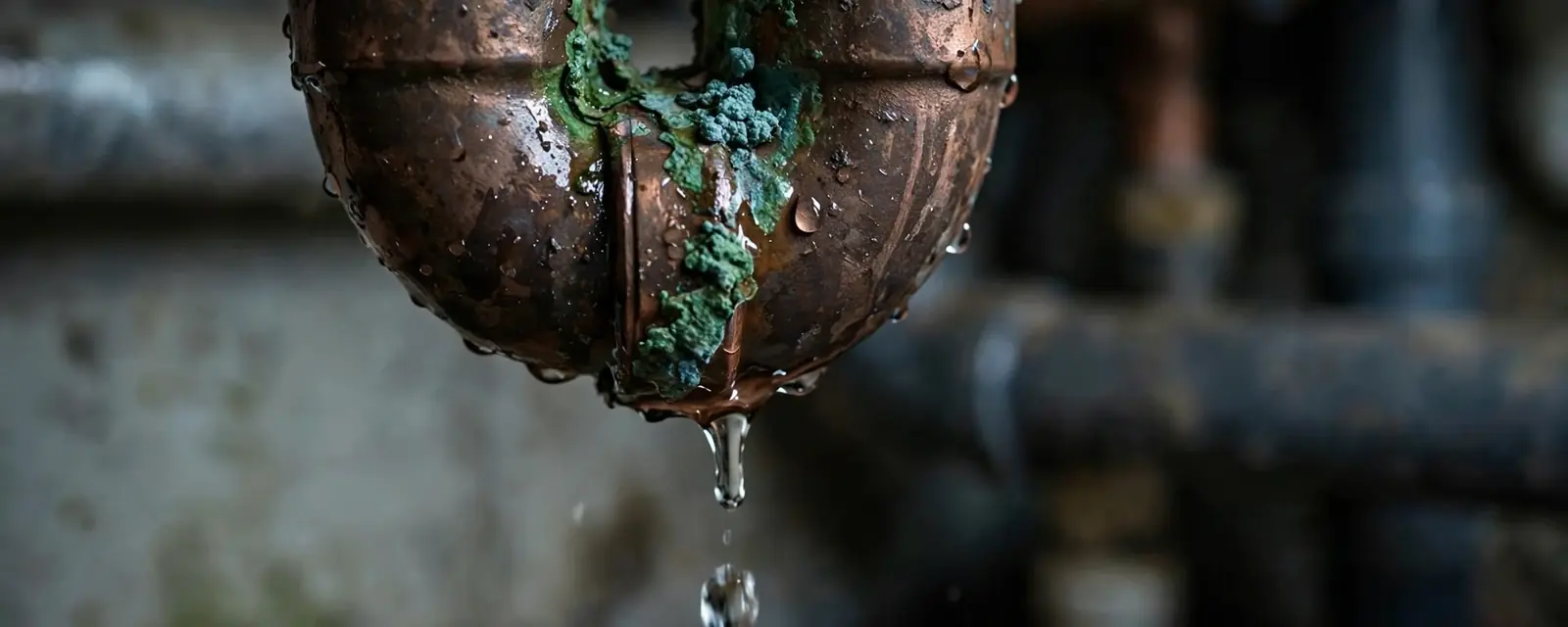
- Corrosion. Metal pipe wears from the inside. Galvanized steel rusts and narrows, copper can develop pinholes, and cast iron drains flake and thin. Water chemistry and age both speed it up.
- Excess pressure. High pressure strains every joint, hose and appliance valve in the house. Hammering pipes and a washer hose that bulges are common signs.
- Failed fittings and connections. Compression nuts, supply stops, solder joints, toilet wax rings and washing machine hoses fail far more often than the pipe between them.
- Freezing. Water expands as it freezes and splits pipe. The crack often shows only after the thaw, usually in exterior walls, crawlspaces and unheated rooms.
- Age and wear. Rubber washers, gaskets and flexible hoses harden over time, and a water heater tank eventually corrodes through.
- Installation errors. Overtightened fittings, poor solder, unsupported runs and joining unlike metals directly can all cause a slow failure years later.
Check your pressure
A simple pressure gauge on an outdoor spigot tells you what your pipes live with. If the reading looks high or the needle jumps, ask a plumber about a pressure reducing valve.
Where the water shows up
| What you see | Likely cause | First move |
|---|---|---|
| Drip under a sink | Failed fitting or worn supply line | Tighten gently or replace the line |
| Green or white crust on copper | Corrosion at a joint | Have the pipe assessed |
| Stain growing on a ceiling | Slow leak above, often a fitting or drain | Find the source before repainting |
| Wet wall after a cold snap | Frozen and split pipe | Shut off the main and call |
| Water around a toilet base | Failed wax ring or supply fitting | Replace the seal or fitting |
| Higher water bill, nothing visible | Hidden leak in wall, slab or yard | Run a meter test, then call |
Seeing a stain or a high water bill?
Call the 24/7 line. A licensed plumber can listen for the leak and open only where it needs opening.
How to find a hidden leak
Shut everything off
Make sure no tap, washer, dishwasher or ice maker is using water.
Read the meter
Note the reading and the small dial or leak indicator, then wait without using water.
Watch for movement
If the dial moves or the number climbs, water is escaping somewhere.
Check the toilets
A few drops of food coloring in the tank show color in the bowl if the flapper leaks.
Call for tracing
A licensed plumber can locate a hidden leak with acoustic listening and a camera.
Hunting for a leak behind a wall or under a slab by guesswork usually means opening more drywall than needed. Leak detection works by listening and inspecting first, so the opening is small and in the right place.
A twice-a-year leak walk-through
What to look at
- Under every sink, for damp cabinet floors, rust on the supply stops or white crust on fittings.
- Behind the toilet and at the base, for moisture, soft flooring or a wobble.
- Washing machine hoses, for bulges, cracks or rusty connections.
- The water heater, for drips, rust streaks or moisture at the pipes on top.
- Exposed pipes in the basement, crawlspace and exterior walls, for stains or insulation gaps before cold weather.
- Ceilings below bathrooms, for new brown rings or paint that bubbles.
Ten minutes of looking catches most small leaks while they are still a drip. Take a photo of anything suspicious so you can see whether it changes. Dissimilar metals joined without the right fitting corrode where they meet, so check those joints first on older plumbing that has been patched over the years.
When a leak becomes a burst
A weeping joint can fail suddenly if pressure spikes or the pipe freezes. When water is running freely, shut off the main valve, open a low faucet to drain the lines and turn off power near any wet outlets. A split pipe is a job for burst pipe repair, and it is an emergency worth a call at any hour.
What shapes the cost of fixing a leak
Fixing a leak is often cheap to start and expensive to leave alone, and these factors decide the size.
Insurance often covers sudden damage like a burst pipe but generally not slow leaks, corrosion or wear, so check your policy and document damage with photos.
Call the 24/7 line, describe what you see, and a clear price comes before work starts.
Nearby, with different water systems
The same causes apply in Livingston and Maplewood. One difference is who to ask about the water. Livingston publishes its own annual water report through the township, while Maplewood is served by NJ American Water, as Millburn is.
Millburn, NJ: what the utility report says about household plumbing
NJ American Water's 2025 Annual Water Quality Report for the Short Hills System lists the typical source of lead and copper in tap water as corrosion of household plumbing systems.
In 2025 sampling at 56 homes, the 90th percentile for lead was 3 ppb against an action level of 15 ppb, with 2 homes above it. Copper came in at 0.23 ppm against an action level of 1.3 ppm, with no homes above it.
Read the takeaway carefully. Those numbers describe a sample of homes, not yours. The report points to inside-the-house plumbing as the typical source, which is why a leaking or corroded pipe in your own house matters. If you want to know what is in your tap water, have it tested by a certified lab, and find the full report at amwater.com/njaw or by calling 800-272-1325.
Source type: NJ American Water 2025 Annual Water Quality Report, Short Hills System
Frequently asked questions
It lists the typical source of lead and copper as corrosion of household plumbing systems. In 2025 sampling at 56 homes, lead was 3 ppb at the 90th percentile against an action level of 15 ppb, and copper was 0.23 ppm against 1.3 ppm.
Your own result can differ, so test your tap with a certified lab if you are concerned.
Failed fittings and connections cause more leaks than the pipe itself. Supply lines, wax rings and compression nuts wear out sooner than copper or PEX.
Yes. It strains joints, hoses and appliance valves, and it often shows up as banging pipes. A gauge on an outdoor spigot tells you where your pressure sits.
Turn off all water, read the meter, wait and read it again. If it moved, water is going somewhere. A rising bill with no visible cause points the same way.
Not always. Some split and leak only when the ice thaws, so a pipe that froze overnight can fail in the morning. Shut off the main and call if you see water.
It may hold briefly, but corrosion usually continues beside the patch. A plumber can show how much of the run is affected before you choose repair or replacement.
Still have a question? Call the 24/7 line and talk it through with a dispatcher.