
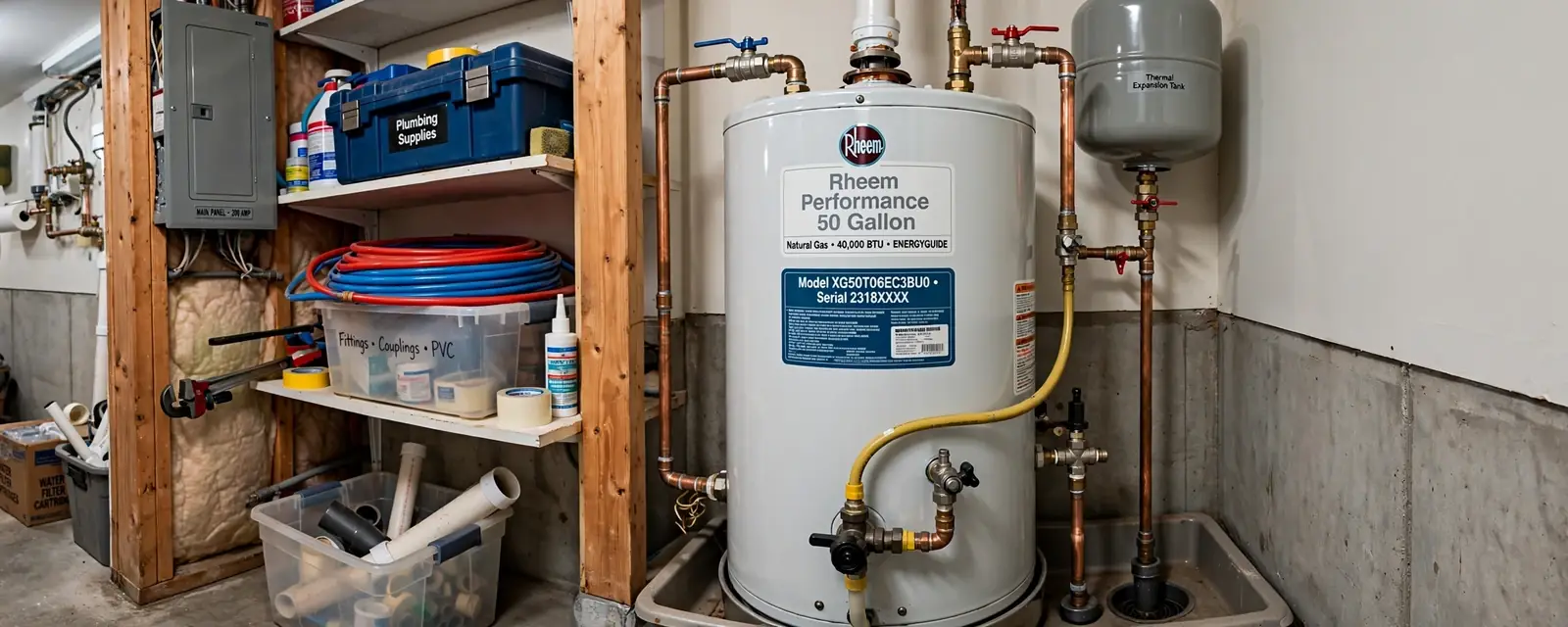
Why two quotes for the same tank do not match
The cost of a 40-gallon water heater installation in Millburn, NJ depends far more on the house than on the tank. Two homes can buy the same size unit and see very different totals, because one has a clear gas flue and a basement floor drain and the other needs new venting and a tight attic climb.
No honest number can be given without seeing the location. What you can do is learn the factors below, so a quote reads as a list of decisions instead of one mystery figure.
Fuel type is the first fork
A gas heater needs a gas supply with a shutoff, a sediment trap, a flexible connector, and a flue path to the outdoors. An electric heater needs a properly sized circuit and breaker for its heating elements, and it has no flue at all.
Changing from one fuel to the other changes the work completely. Gas to electric can mean a new circuit and panel capacity, and electric to gas means a gas line and a vent. A like-for-like swap is the simplest case.
Venting and the flue
Gas heaters vent in different ways. An atmospheric unit uses a draft hood and a metal flue rising to a chimney, while a power vent uses a fan and plastic pipe through a wall. Direct vent units draw air from outside and exhaust back out.
If the old flue or chimney liner is corroded, undersized or poorly pitched, it has to be corrected before the new heater is lit. Venting problems can be a safety matter, and they are usually the largest swing on a gas replacement.
Expansion tank and the code items
When a home has a backflow preventer or a pressure reducing valve, heated water has nowhere to expand, and a small expansion tank absorbs it. Without one, pressure can climb until the temperature and pressure relief valve starts dripping.
Other code items include a relief valve discharge pipe that runs downward to a safe spot, shutoff valves, a drain pan where needed, and gas or electrical connections that meet current rules. New Jersey's plumbing subcode follows the National Standard Plumbing Code, and permit rules vary, so ask the Millburn building department what applies.
Need a heater quote that lists the details?
Call the 24/7 line and a licensed plumber can walk through the fuel, the vent and the access.
Access and removal of the old unit
A heater in an open basement with a floor drain is easy to swap. A heater in a tight closet, an attic or at the bottom of a narrow stair takes more time and more hands, because a full tank is heavy and the old one has to come out the same way.
Ask every installer whether removal and disposal of the old heater is part of the quote. Do not assume.
The cost factors in one place
These are the factors that move the total on a 40-gallon replacement, listed in the order they usually matter.
Homeowner insurance often covers sudden water damage from a failed heater but rarely pays to replace the heater that wore out, so check your policy.
Call the 24/7 line and a licensed plumber can look at the space, the vent and the fuel, then give you a clear price before work starts.
Is 40 gallons the right size
A 40-gallon tank is a common choice for a household of about two to four people, but peak use matters more than headcount. Two showers back to back plus a dishwasher is a harder test than a quiet week.
If you often run out of hot water, ask about the recovery rate, which is how quickly the unit reheats, before you step up in size. A bigger tank also needs more floor space and may not fit through the door of the room it lives in.
Decision table, how the choice moves the total
| Question to ask | If the answer is simple | If the answer is complex |
|---|---|---|
| Same fuel as the old unit? | Lower labor | Conversion work added |
| Flue or vent in good shape? | Reuse it | Repair or new venting |
| Closed water system? | Add an expansion tank | Check the existing one |
| Easy path to the heater? | Short job | More labor |
| Old unit removed? | Included | Ask what is extra |
Our crew handles water heater installation for new locations and fuel changes, while a straight swap of a failed tank is water heater replacement. Both start with a look at the space.
Questions to ask before you accept a quote
- Is the new heater the same fuel as the old one, and if not, what work does the conversion add?
- What happens to the flue, and will it be inspected or replaced?
- Does the quote include an expansion tank, a discharge pipe and new shutoff valves?
- Are permit and inspection steps included, or left to me?
- Is the old heater removed and disposed of, and is that written down?
- What will you do if the space turns out to be harder to work in than it looks?
A written answer to each of those makes two quotes comparable. Where a line is missing, it is usually either not needed or being saved for a surprise later.
Neighboring towns, same checklist
The checklist applies in Maplewood too, and the same questions about fuel, flue and access come first. In Livingston the water comes from the township's own department, so the water report to read is the township's, not the NJ American Water one referenced below.
Millburn, NJ: hard water, sediment and the anode rod
NJ American Water's 2025 report for the Short Hills System lists total hardness from 52 to 342 mg/L. The report does not say which streets get which value, so your own tap may sit anywhere in that range. You can find the report on the utility's website under the Water Quality tab by ZIP, or call 800-272-1325.
Hard water leaves scale and sediment on the bottom of a tank, and it speeds the use of the anode rod, the sacrificial rod that protects the steel from rust. Water chemistry changes how fast that rod is spent, so a tank in harder water can need attention sooner.
The takeaway is to test your tap before the install. If your water is hard, ask the installer how the anode rod can be checked later and plan a yearly flush of the tank.
Source type: NJ American Water 2025 annual water quality report
Frequently asked questions
Often yes, when the house has a pressure reducing valve or backflow preventer that makes it a closed system. A plumber can check with a gauge, and a local permit office can say what it requires.
The conversion itself adds work, such as a new circuit and breaker capacity, and removes the flue. Whether the change makes sense depends on your panel and your running costs.
The flue carries exhaust gases out of the house. If it is damaged, undersized or wrong for the new unit, it has to be corrected before the heater can be used safely.
For many households of two to four people it is. If two showers and a dishwasher regularly overlap, ask about recovery rate or a larger tank.
Permit rules vary, so ask the Millburn building department. New Jersey's plumbing subcode is based on the National Standard Plumbing Code, and a licensed plumber can tell you what the job involves.
Read the NJ American Water report for your ZIP on the utility's website, or call 800-272-1325, and then test your own tap. The Short Hills System lists 52 to 342 mg/L, so your tap can differ from a neighbor's.
Still have a question? Call the 24/7 line and talk it through with a dispatcher.