
Test the whole house before you take anything apart
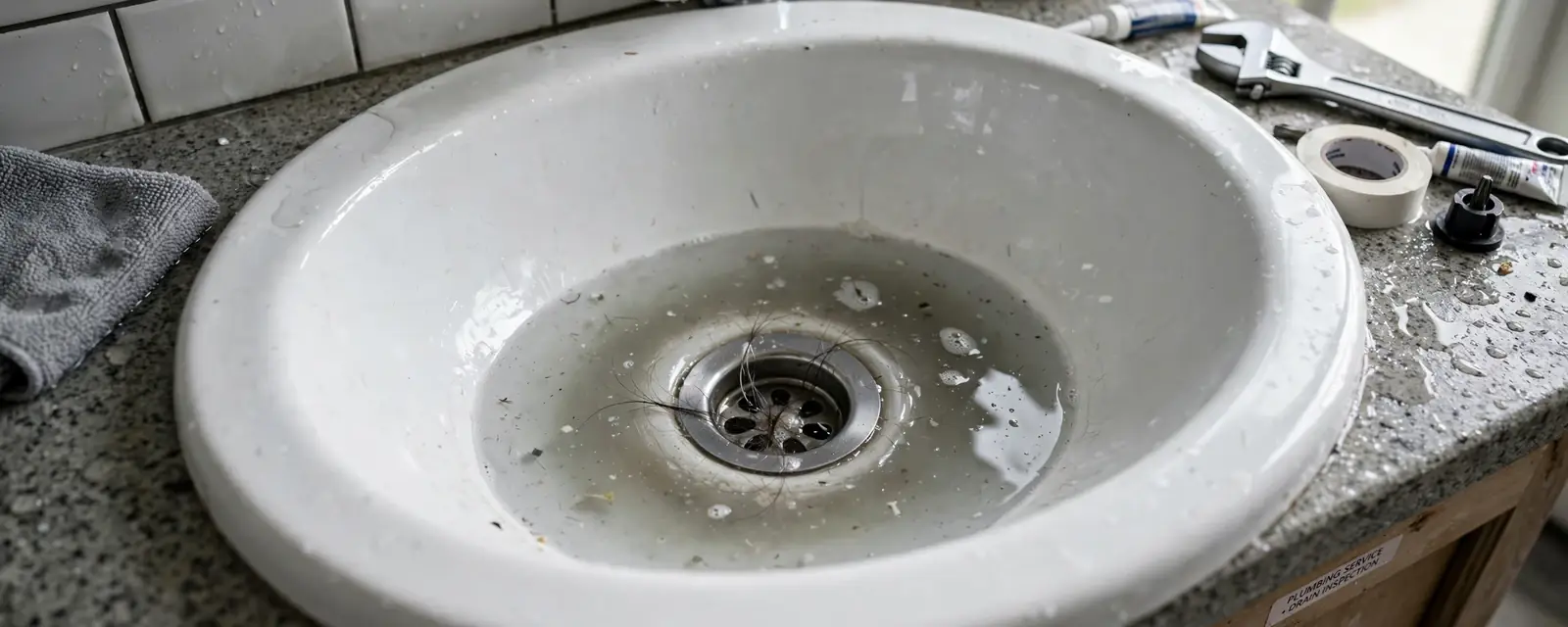
A slow bathroom sink drain in Millburn, NJ homes is almost always a partial blockage rather than a full one, and the blockage is usually within arm's reach of the basin. Hair and soap stick to the pop-up stopper, then to the walls of the tailpiece, and the water slows long before it stops.
Before you reach for tools, run a quick test. Fill the sink, then also check the tub, the toilet flush and the lowest drain in the house. If only one sink is slow, the problem is local. If several fixtures slow together, it is not the stopper.
| What you see | Most likely location | First move |
|---|---|---|
| Only this sink is slow | Stopper, tailpiece or P-trap | Clean the stopper and trap |
| Slow and gurgling | Partial vent or deeper blockage | Check other fixtures, then call |
| Sink and tub both slow | Shared branch line | Call for line clearing |
| Lowest drain backs up | Main line | Stop using water and call |
Rung one, the stopper and the first six inches
Most bathroom sinks use a pop-up stopper linked to a lift rod behind the faucet. A pivot rod enters the tailpiece from the back, held by a nut, and it is the favorite place for a hair snag. Loosen that nut, slide the rod and stopper out, and wipe away the gray slime you find.
The faucet's lift rod also passes through the faucet body, so a loose or leaking faucet base and a stuck stopper can be repaired in the same visit by a licensed plumber doing faucet repair.
Look under the sink
Find the horizontal pivot rod where it enters the back of the tailpiece, held by a small nut.
Unscrew the pivot nut
Loosen it by hand, pull the rod free of the clevis strap, and lift the stopper straight out of the basin.
Clean everything you removed
Wipe off the hair, soap and slime with a rag and an old toothbrush, and flush the drain opening with hot tap water.
Reinstall and test
Seat the rod through the stopper's hole, tighten the nut, and check that the stopper lifts and seals.
Cover the overflow before you plunge
A bathroom sink has an overflow opening near the top of the basin. Cover it with a wet rag when you plunge, or the pressure escapes instead of pushing on the blockage.
Rung two, the P-trap
Set a bucket under the trap
The U-shaped trap holds standing water and often a ball of hair and soap.
Unscrew the slip nuts by hand
Loosen both nuts, and use a wrench gently only if they resist. Metal and plastic traps both crack under force.
Empty and rinse the trap
Dump it into the bucket, clean out the sludge, and check the washers for flattening.
Reconnect hand tight
Seat the washers flat, snug the nuts, and run water to look for weeping at the joints.
If the trap is clean and the sink is still slow, the blockage is past it in the wall or in a branch. Go no further with a hanger or a long wire, which can scratch the pipe or push the clog deeper.
Several drains slow at once?
Call the 24/7 line and a licensed plumber can clear the branch and look at the main line.
Rung three, vent clues
Every drain needs air behind it. A vent stack rising through the roof lets air in so water can flow without a vacuum, and a partly blocked vent makes a drain sound labored. Slow draining with a glug or a burp as the water leaves is a classic sign.
Vent work usually means roof access, which is not a casual DIY task. A vent can clog with leaves, a bird's nest or ice, and the sign is often that the sink drains better at some times than others. If you suspect a vent, leave the ladder alone and ask a licensed plumber to confirm before you climb anything.
Rung four, when it is the main line
Signs it points beyond the sink
- More than one fixture drains slowly at the same time
- A toilet burps when the sink empties
- The lowest drain in the house shows water or odor
- A cleaned stopper and trap made no difference
- The slowdown comes back each time it rains
A plumber doing drain cleaning can run a cable through the branch line, then follow with a camera to see what is left. Chemical openers are a poor shortcut here, since they sit in the trap and risk burns when the next person opens it.
If the cable finds a lot of debris or roots, the camera shows whether the pipe itself is cracked, sagging or offset. That is the difference between a one-time clearing and a repair, and it is the reason a repeat slowdown deserves a look inside the line.
What not to do to a slow sink
- Do not push a wire hanger or stiff wire into the drain, because it can scratch a plastic tailpiece or shove the clog farther in
- Do not mix chemical openers or follow one with vinegar
- Do not force a rusted slip nut with a pipe wrench until it cracks
- Do not keep running water into a basin that is already near the rim
- Do not ignore a gurgle that has spread to other fixtures
Nearby towns and the same ladder
The steps do not change across Springfield and West Orange. What does change from house to house is the pipe material behind the wall, so check what yours are made of before you use any tool on them, since cast iron and plastic respond differently to force.
What changes the cost of a slow drain call
- How far from the sink the blockage sits
- Whether one fixture or the whole branch is slow
- Whether a camera look is needed to find the cause
- Access to a cleanout, and whether the trap needs to come off
- Whether a vent is involved
- Time of day, since after-hours dispatch differs from a daytime visit
Millburn, NJ: when slow drains follow the rain
The remnants of Ida hit on the night of September 1, 2021. The West Branch of the Rahway River overflowed into the streets of Millburn, and in the South Mountain area basements filled with water and sewage. Millburn had also flooded in Hurricane Floyd in 1999 and Hurricane Irene in 2011.
Heavy rain does not mean your sink problem is a sewer problem, since hair at a stopper is slow in any weather. The clue is timing. A sink that drains well on dry days and slows only after hard rain, especially when the lowest fixtures slow first, points toward the main line and not the stopper.
The takeaway is to note when the slowdown happens. If it follows the weather, skip the trap cleaning, stop adding water to the system, and have the main line inspected.
Source type: ENR and Patch reporting on Hurricane Ida
Frequently asked questions
The sink has its own tiny tailpiece and trap, which fill with hair and soap quickly. A tub has a larger drain, so one can clog while the other runs freely.
It is better not to. The product can sit in the trap and splash on the next person who opens it, and it does little against hair. Mechanical cleaning works better and is safer.
Gurgling usually means air is pulling through the trap because of a partial blockage or a partly blocked vent. If it shows up with slow fixtures elsewhere, have the line checked.
Yes, with a small cup plunger and the overflow covered with a wet rag. Use gentle strokes, and stop if water rises in other fixtures, since that suggests a shared blockage.
Count the fixtures. When several slow together, or the lowest drain in the house backs up, the problem is likely beyond the sink. A single slow basin is usually local.
It can when the main line is stressed. Ida's remnants overflowed the West Branch of the Rahway River in 2021 and filled South Mountain area basements with water and sewage. If your drains slow only after hard rain, note it and call a plumber about the main line.
Still have a question? Call the 24/7 line and talk it through with a dispatcher.