
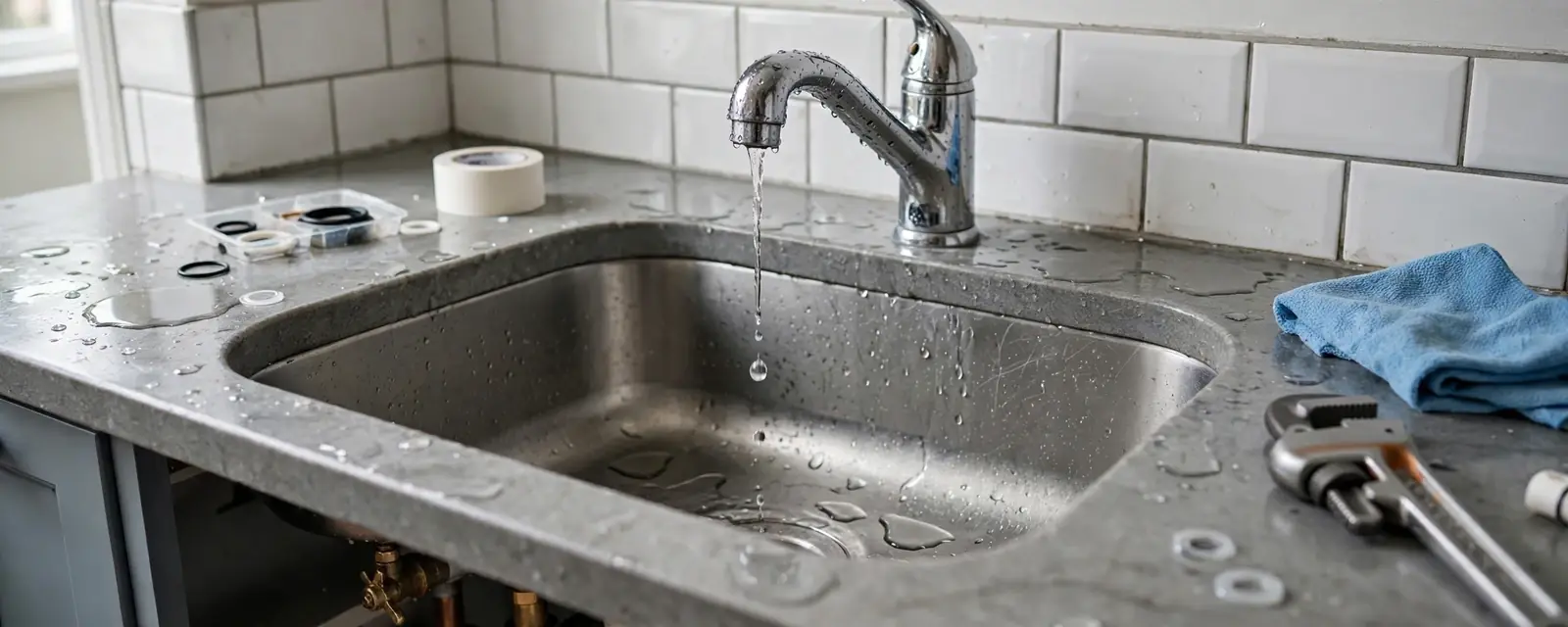
Start with the shutoff, then read the leak
To repair a leaking sink faucet in Millburn, NJ, shut off the water first, then work out where the drip starts. A leak at the spout usually means a worn seal inside. A leak at the handle or base usually means an O-ring or a tired cartridge. A puddle under the sink often has nothing to do with the faucet at all.
That last point matters, because many people replace a good faucet to chase a leak that was a supply line or a drain joint.
Find the shutoff before you touch a tool
Look for two small oval or round valves under the sink, called angle stops, and turn each clockwise until it stops. Open the faucet to bleed off pressure and confirm the flow has stopped. If a stop will not turn or keeps weeping, close the main water valve for the house and call a licensed plumber.
Where the water appears
Leaking from the spout
A steady drip from the tip after the handle is off usually points to a worn washer and seat in an older two-handle faucet, or a worn cartridge or disc in a single-handle one. The part inside no longer shuts the flow tight, so a little water slips past with every minute.
Leaking around the handle
Water that creeps out under the handle or runs down the neck is typically a failed O-ring or packing seal around the stem or cartridge. On a handle that has also gone stiff, scale on the cartridge body can be the real cause.
Leaking at the base of the spout
A swiveling spout rides on one or two O-rings, and when they harden the water runs out of the base every time you use the faucet. This is a straightforward fix when you can pull the spout, but a cracked body means a new faucet.
Leaking underneath the sink
Check the braided supply lines at both ends, the shutoff valve stems, and the drain trap with a dry paper towel. A supply line nut that has loosened with time can be snugged about a quarter turn, but a kinked or frayed line should be replaced.
Cartridge, ball and disc, in plain terms
| Type | How to spot it | What usually wears out |
|---|---|---|
| Compression | Two handles that turn several times | Rubber washer and brass seat |
| Cartridge | Single or double handle, smooth movement | O-rings or the cartridge itself |
| Ball | One handle on a rounded cap | Springs, rubber seats and O-rings |
| Ceramic disc | One handle, wide cylinder under it | Rubber seals around the disc plates |
Take photos as you take the faucet apart and bring the old cartridge or the parts kit to a plumbing supply counter to match it. Faucet makers change cartridge styles from one model year to the next, and a near match often leaks again.
Faucet still dripping after a new cartridge?
Call the 24/7 line and a licensed plumber can trace whether it is the faucet, the stops or a hidden line.
Parts and tools to have on the counter
- An adjustable wrench and a set of hex keys, since most handle set screws are hex
- A small flat screwdriver for prying decorative caps without scratching them
- Plumber's grease for the new O-rings, never petroleum jelly, which can swell rubber
- A repair kit or cartridge matched by brand and model, or the old part in a bag
- A towel in the cabinet and a bowl for the small parts
Keep the old parts until the new ones are tested. If the leak returns, the old cartridge is the fastest way to prove the replacement was the wrong match.
A basic repair, step by step
Close the stops and plug the drain
Turn off the angle stops, open the faucet, and stuff a rag in the sink drain so small screws do not disappear.
Remove the handle
Pry off the cap, back out the set screw, and lift the handle away from the stem.
Pull the cartridge or seals
Take off the retaining nut or clip, then lift out the cartridge, disc or ball assembly and the old O-rings.
Clean the seats
Wipe out the body and remove any white crust or grit that would stop the new part from sealing.
Reassemble with new parts
Coat new O-rings with plumber's grease, seat the cartridge in the right orientation, and rebuild in reverse order.
Test slowly
Open the stops partway, run the faucet, and check the handle, spout and base for weeping before you close up.
When the leak is not the faucet
If the cabinet floor is wet but every faucet joint is dry, the water may be coming from a supply line, a shutoff valve, a drain joint, or a pipe in the wall behind. A plumber doing leak detection can pressure test the line and listen for water moving where nothing should be, which is far better than guessing and cutting drywall.
The same applies in nearby Summit and across the township. A wet vanity can hide a leak that started somewhere else, so check the cabinet floor, the wall behind it, and any ceiling below for staining.
Repair or replace the faucet
Signs the faucet is past repairing
- Pitting, corrosion or cracks in the faucet body
- A finish that is peeling, so water gets under the plating
- Parts that are no longer sold for your model
- Leaks at more than one point after a fresh cartridge
- A handle that spins freely because the threads are stripped
When that list describes your faucet, professional faucet repair usually ends in a swap to a new fixture with fresh stops and supply lines, so the whole sink is tight at once.
What changes the price of a faucet repair
- Faucet type, since a ball or cartridge faucet needs different parts
- Whether the shutoff valves under the sink still close
- The condition of supply lines and the drain below
- Access under a tight vanity
- Whether the leak is the faucet at all, or a hidden line
- Repair of the old fixture compared with replacement
A note for Livingston households
Homes in Livingston draw water from the township's own supply, so the minerals your faucet sees can differ from a Millburn kitchen. The cure for a slow weep is the same, a clean cartridge and sound seals.
Millburn, NJ: hard water, aerators and the cartridge
The utility's own 2025 water quality report for the Short Hills System lists total hardness across a range of 52 to 342 mg/L. The report does not say which streets get which value, so your tap can differ from your neighbor's down the block.
That range matters at the faucet. Hard water leaves chalky scale on aerators, inside spouts and on cartridge bodies, which can stiffen a handle and cut the seal that stops a drip. Unscrew the aerator and look for white crust in the screen.
The takeaway is to test your tap with a hardness test strip or a lab kit before buying parts. If the scale is heavy, expect to clean the aerator more often and to inspect the cartridge as soon as a handle starts to feel stiff.
Source type: NJ American Water 2025 annual water quality report
Frequently asked questions
Remove the handle and look. A ball faucet shows a rounded cap and springs, a disc faucet shows a wide ceramic cylinder, and a cartridge faucet has a slim brass or plastic insert. Take photos before you disassemble anything.
Yes. A drip wastes water you pay for and can wear the seat, so a cheap seal becomes a replacement part. A drip can also be the first sign of a worn cartridge.
Scale or mineral buildup on the stem and cartridge is a common cause, along with dried grease on the O-rings. Cleaning the cartridge or replacing the O-rings often brings it back.
The cartridge may be the wrong match, or the seat inside the body may be pitted. A leak at the base or under the sink is also a different part. A plumber can test each joint.
The stops under the sink are enough when they work. If a stop is stuck, leaking, or you cannot find it, use the main water valve for the house and call a licensed plumber.
It can contribute. The NJ American Water 2025 report for the Short Hills System lists hardness from 52 to 342 mg/L, and scale can stiffen handles and wear cartridges. Test your own tap, since the range does not tell you which value reaches your faucet.
Still have a question? Call the 24/7 line and talk it through with a dispatcher.