
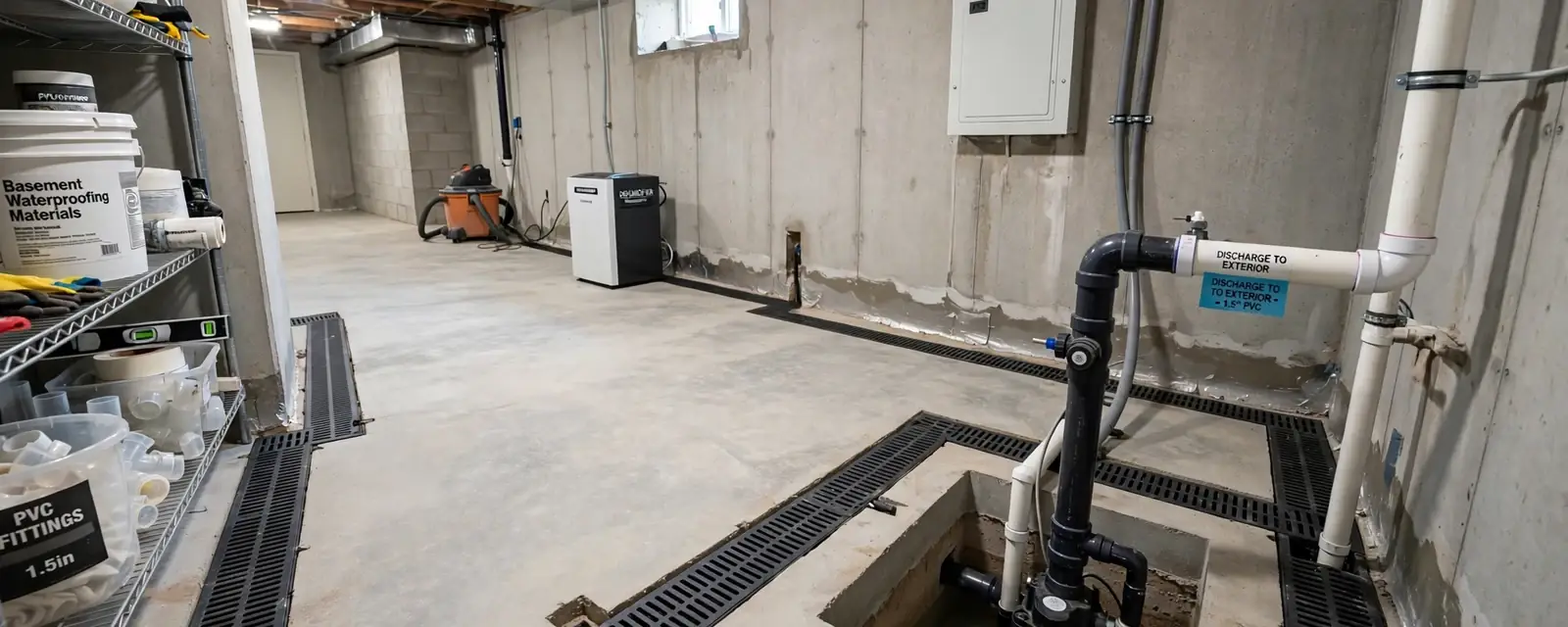
What a plumber does and does not do about a wet basement
Basement waterproofing in Millburn, NJ usually means two different trades. Waterproofing contractors handle exterior membranes, foundation crack injection and wall work. A plumber handles the water that has to be moved or drained from inside the house. Knowing which problem you have saves you from paying the wrong person.
Our licensed plumbers work on the sump pit, the pump, the check valve, the discharge line, floor drains, backwater and sewage backup risk, and any leaking pipe that looks like wall seepage. We do not dig out foundations or apply exterior coatings. When a wall crack or exterior membrane is the real answer, we will say so.
Same-day appointments are offered when the schedule allows. Water that is rising now is a different call, so use the 24/7 line and read the page on emergency sump pump repair.
Where basement water really comes from
Most wet basements trace to one of four sources. Surface water pools against the house and soaks in, a downspout dumps roof runoff at the foundation, groundwater rises with a high water table, or a pipe inside the house is leaking. The fix for each is different, and treating the wrong one wastes money.
| What you see | Likely source | Who usually fixes it |
|---|---|---|
| Water at the floor and wall joint after heavy rain | Rising groundwater | Sump system, possibly a waterproofing contractor |
| Wet wall below a downspout | Roof runoff at the foundation | Gutters and grading, homeowner or yard contractor |
| Damp patch that appears on dry days | Supply pipe leak | Plumber, with leak detection |
| Water rising at a floor drain | Drain or sewer backup | Plumber |
| Seeping hairline crack in the wall | Foundation crack | Waterproofing contractor |
| Puddle by the water heater or boiler | Tank or connection leak | Plumber |
| Musty smell, no visible water | Humidity or a dry drain trap | Dehumidifier, plumber for the trap |
Not sure if it is plumbing or the wall?
Call and describe when the water shows up. A licensed plumber can tell you whether it is a pipe, a drain or a job for a waterproofing contractor.
Surface water and downspouts come first
Check the cheap causes before the expensive ones. Downspouts that end at the foundation, gutters packed with leaves and soil that slopes toward the house all push water against the wall. Extending downspouts several feet away and fixing the grade costs far less than any system inside the house.
A plumber will not sell you a pump to fix a downspout problem. If the water arrives only during rain and shows up under a roof corner, start outside. If it persists after that, the sump and drain system inside the house is the next step.
What Ida taught South Mountain area basements
When the remnants of Ida arrived on the night of September 1, 2021, the West Branch of the Rahway River overflowed into Millburn's streets. In the South Mountain area, basements filled with water and sewage. Floyd in 1999 and Irene in 2011 flooded Millburn too.
The practical takeaway is that a basement can take in water two ways at once, through the walls and floor and back up through the drains. A pump helps with the first and does little for the second. A backwater valve is a plumbing device that keeps sewage from flowing back into the house, and it is worth asking about if you live where sewage came into basements.
The plumbing side, sump pit, pump and discharge
The sump pit collects water from drain tile or from under the slab, and the pump sends it outside. The plumber sets the pit, sizes the pump, adds a check valve and runs the discharge line away from the foundation. Ask the Millburn building department about discharge rules before routing it.
Battery backup, a sealed lid and a float that moves freely turn a basic pit into one that can handle a storm. If your pump is old or runs constantly, sump pump repair and replacement is the next page to read.
Floor drains, backwater and sewage backup risk
A floor drain lowers standing water in a basement, but it connects to the same system that serves the house. If the main drain backs up in a storm, the floor drain is where the water comes out. A basement that fills with gray or foul water is a sewer problem, not a seepage problem.
A plumber can camera the line, clean it, and discuss a backwater valve. If the problem is in the line between the house and the street, sewer line repair is the next page to read. Dry traps also let odor in, and pouring water into a seldom used drain restores the seal.
Leaking pipes that look like seepage
A pressurized supply line can leak into a slab or behind drywall and look exactly like groundwater. The giveaway is timing. A wet spot that grows on a dry week is probably plumbing, not weather. A plumber can test the water meter, listen to the pipes and use leak detection to find the source without tearing out walls.
Shut every fixture
Turn off all taps and appliances that use water.
Read the meter
Note the meter dial or low-flow indicator.
Wait and read again
If it moved with everything off, a supply pipe is leaking.
Check the damp spot
Does it grow on dry days? That points to a pipe, not the weather.
Call
Give the plumber what you saw and when.
Springfield homeowners ask the same question
Basements in nearby towns face the same split between plumbing and waterproofing. Springfield borders Millburn and the Rahway River Parkway greenway runs through it, so homeowners there start with the same checks. The first test is whether the water follows the weather or ignores it.
What shapes the cost of the plumbing side
The plumbing part of a wet basement depends on what the diagnosis finds.
Homeowner insurance often excludes groundwater and sewer backup unless you have a specific endorsement, and sudden pipe leaks are treated differently. Check your policy.
Call to describe the problem and get a clear price before work starts.
Frequently asked questions
A plumber handles the drainage inside the house, such as the sump pit, pump, discharge, floor drains and leaking pipes. Exterior membranes and crack injection are waterproofing contractor work.
Timing is the clue. Water that appears after rain points to groundwater, while a spot that grows on dry days points to a pipe. A meter test with everything off helps confirm it.
It keeps up with groundwater that collects at the pit. It will not stop a river from overflowing or sewage from backing up through drains, which is what happened in the South Mountain area during Ida.
It is a valve on the sewer line that lets wastewater leave the house but closes against flow coming back. Ask a plumber whether it suits your line, and ask the Millburn building department about permits.
Yes, they are the cheapest cause to fix. Extend them away from the house and check the grade near the foundation.
No. Those are waterproofing contractor jobs. We handle the plumbing side and will tell you plainly when the wall is the real problem.
Still have a question? Call the 24/7 line and talk it through with a dispatcher.